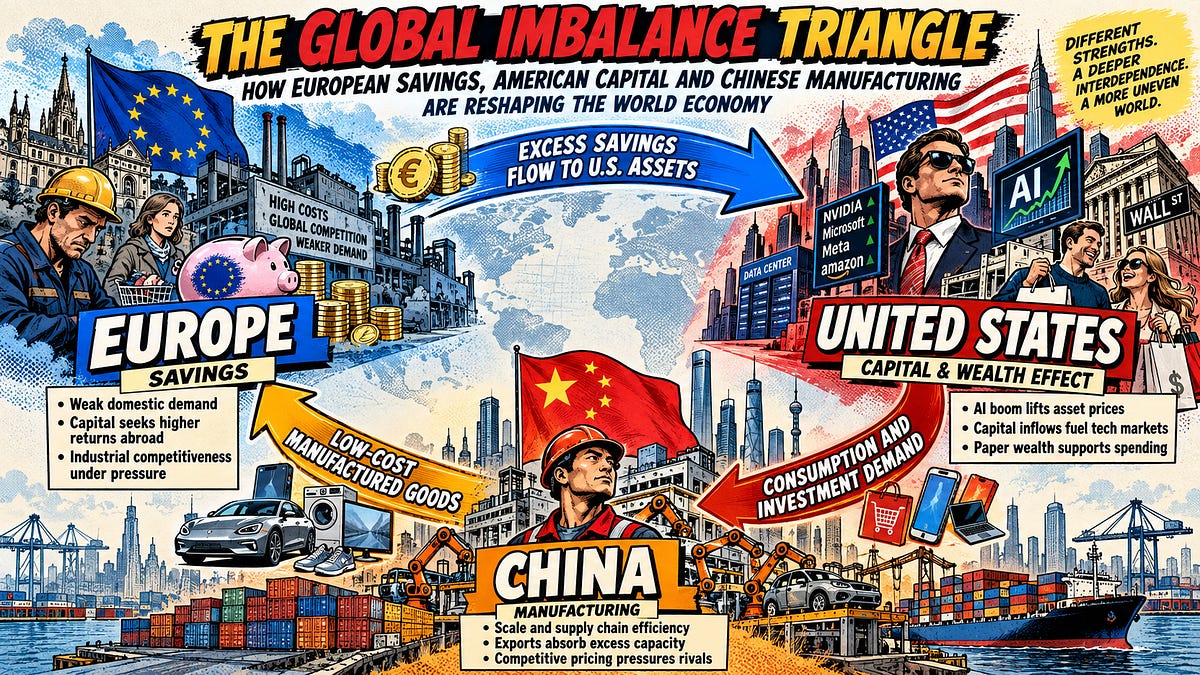
The Global Imbalance Triangle: How European Savings, American Capital and Chinese Manufacturing Are Reshaping the World Economy The global economy is increasingly defined by an uncomfortable division of labour. Europe accumulates savings but struggles to turn them into domestic innovation. America attracts global capital and converts technological leadership into financial wealth. China continues to expand its manufacturing capabilities, even as domestic demand struggles to keep pace. Each model makes economic sense on its own. Together, they create imbalances that are becoming harder to ignore. Europe Has Plenty of Savings, but Too Few Growth Engines Europe faces an economic paradox. It possesses enormous private wealth, sophisticated financial institutions and some of the world’s most advanced industrial companies. Yet when it comes to artificial intelligence, cloud computing and digital platforms, the continent has struggled to produce businesses capable of matching the scale of America’s technology giants. In his 2024 report on European competitiveness, Mario Draghi, the former president of the European Central Bank, estimated that the European Union would need an additional €750 billion to €800 billion in annual investment to support technological innovation, digitalisation, energy transition and industrial competitiveness. The problem is not simply a shortage of money. Europe’s capital markets remain fragmented, scaling businesses across national borders is difficult, and high energy costs, demographic pressures and regulatory complexity can weaken investment incentives. Consequently, a portion of European savings flows abroad through pension funds, insurance companies and asset managers. American equities and bonds have become particularly attractive destinations, supported by deep capital markets, a highly liquid financial system and the growth prospects of leading technology companies. This does not mean that European workers are deliberately suppressing their wages to finance Silicon Valley. Wage restraint has played a role in the competitiveness strategies of some export-oriented European economies, particularly Germany, but household saving behaviour is influenced by many other factors, including ageing populations, pension systems, income distribution and economic uncertainty. The more important issue is Europe’s difficulty in transforming accumulated wealth into productive domestic investment. European investors can benefit financially from America’s technological success. But owning shares in an American AI company is not the same as developing an AI industry at home. Financial returns may flow back to Europe, while the associated employment, intellectual property, entrepreneurial ecosystems and technological capabilities remain concentrated elsewhere. Over time, this distinction matters more than the geographical location of investment portfolios. [ ]( https://tspasemiconductor.substack.com/p/ecoc-2026-plenary-takeaways-how-ciena ) [ ECOC 2026 Plenary Takeaways: How Ciena, imec, Huawei, and PsiQuantum Are Redefining Optical Infrastructure for the AI Era Sep 21 ]( https://tspasemiconductor.substack.com/p/ecoc-2026-plenary-takeaways-how-ciena ) [ Read full story ]( https://tspasemiconductor.substack.com/p/ecoc-2026-plenary-takeaways-how-ciena ) America Attracts Global Capital, but Financial Wealth Is Not the Same as Economic Productivity At the opposite end of this relationship sits the United States. America combines the world’s deepest capital markets with leading positions in software, semiconductor design, cloud computing and artificial intelligence. Companies such as Nvidia, Microsoft, Alphabet and Amazon have become central to the expectations surrounding the next technological revolution. The AI investment boom has reinforced America’s ability to attract international capital. Investors are willing to pay substantial premiums for companies expected to dominate future computing markets, while technology groups are committing enormous sums to data centres, AI accelerators, networking equipment and electricity infrastructure. Rising equity prices can support household spending through what economists call the wealth effect. As the value of investment portfolios and retirement accounts increases, some consumers become more willing to spend and less inclined to save. Yet this mechanism is frequently misunderstood. When a European investor purchases Nvidia shares on the secondary market, the money generally goes to another investor, not directly to Nvidia. Higher share prices may improve a company’s financing options, acquisition capacity and confidence, but stock-market transactions are not automatically equivalent to new investment in physical infrastructure. Nor is the wealth effect evenly distributed. Higher-income American households own a disproportionate share of financial assets and consequently capture more of the gains from rising equity markets. For much of the population, consumption remains more closely tied to wages, employment, borrowing costs and inflation. It would therefore be misleading to suggest that America simply uses European savings to inflate technology stocks before spending the resulting paper wealth on imported goods. America possesses genuine technological advantages, strong domestic consumption, valuable intellectual property and institutions that attract international investment. The more consequential question is whether the expected economic benefits of artificial intelligence will eventually justify the capital being deployed. If AI investment continues to accelerate while revenues, productivity improvements and operating profits develop more slowly, financial markets may be forced to reassess the economic returns on this infrastructure. Such an adjustment would not remain confined to Wall Street. It could also affect the international supply chains building the underlying hardware. [ ]( https://tspasemiconductor.substack.com/p/why-us-tech-podcasts-scaleand-taiwans ) [ Why U.S. Tech Podcasts Scale—and Taiwan’s Don’t ]( https://tspasemiconductor.substack.com/p/why-us-tech-podcasts-scaleand-taiwans ) SEMIVISION · Aug 20 [ Read full story ]( https://tspasemiconductor.substack.com/p/why-us-tech-podcasts-scaleand-taiwans ) China’s Manufacturing Strength Creates a Different Imbalance China represents another side of the global economy: an extraordinary capacity to produce physical goods. Over several decades, the country has developed a manufacturing ecosystem extending from raw materials and industrial machinery to electronic components and final assembly. Extensive infrastructure, engineering capabilities, domestic scale and tightly integrated supply chains have enabled Chinese manufacturers to compete aggressively on both cost and delivery. [ ]( https://tspasemiconductor.substack.com/p/the-next-optical-cycle-is-not-about ) [ The Next Optical Cycle Is Not About Modules: SemiVision’s Key Observations from CIOE 2026 ]( https://tspasemiconductor.substack.com/p/the-next-optical-cycle-is-not-about ) SEMIVISION · Sep 15 [ Read full story ]( https://tspasemiconductor.substack.com/p/the-next-optical-cycle-is-not-about )Read More

The Global Imbalance Triangle: How European Savings, American Capital and Chinese Manufacturing Are Reshaping the World Economy
 By SEMIVISION