

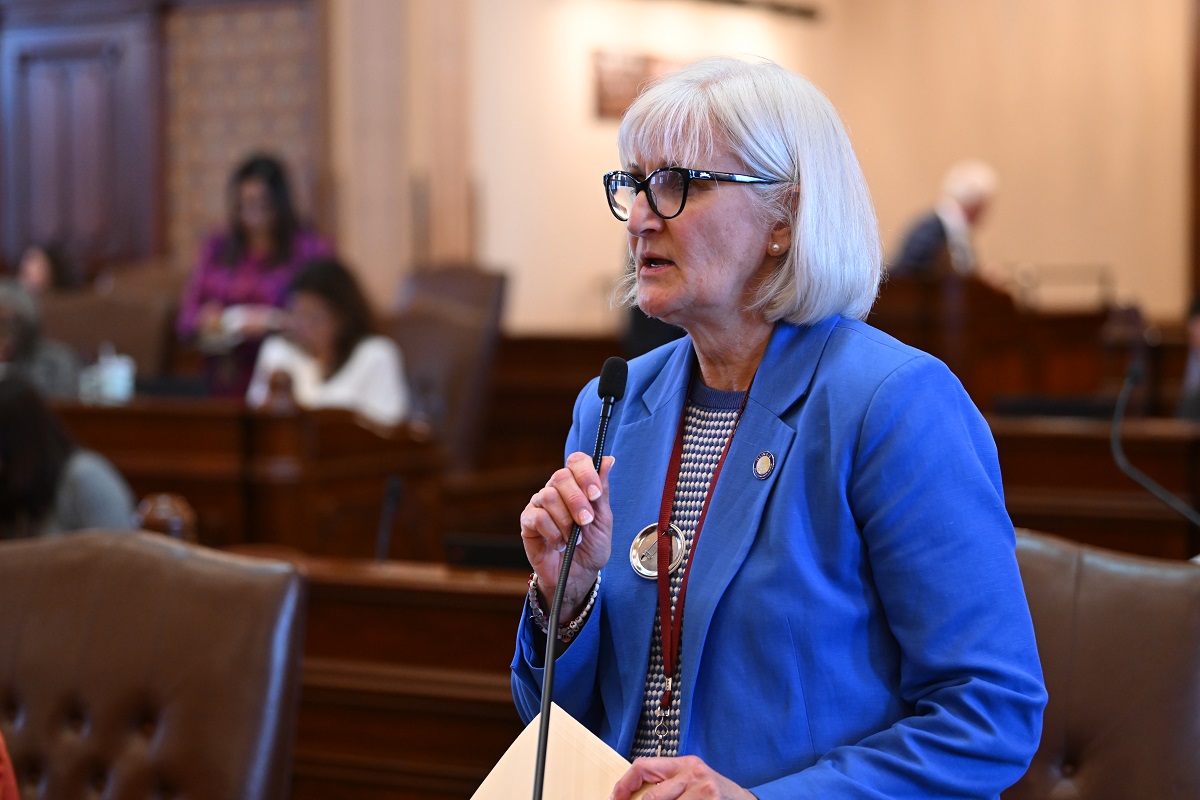
Disruption Q&A: Illinois’s Mary Edly-Allen, on passing AI safety law The state senator introduced the bill that made her state just the third to enact such a law. Austin Jenkins 06:00 AM, Sep 07, 2026 Illinois state Sen. Mary Edly-Allen (D) (Courtesy of Edly-Allen’s state Senate office) Illinois this year became the third state, after California and New York, to enact an artificial intelligence safety law aimed at preventing powerful frontier models from unleashing cyber or nuclear attacks or other catastrophic harm. The senator who sponsored the legislation, Democrat Mary Edly-Allen, cuts a low profile compared to California Sen. Scott Wiener and New York Assemblymember Alex Bores, both Democrats and authors of their state’s laws. Read more: After AI models breached security, state lawmakers demand labs slow the race Edly-Allen, a bilingual educator, told Pluribus News she got interested in regulating the tech industry after watching “The Social Dilemma,” a 2020 documentary about social media harms. She was further galvanized after seeing a 2023 video called “The A.I. Dilemma.” Both featured Tristan Harris, a former design ethicist at Google who is co-founder and president of the Center for Humane Technology. Edly-Allen said Harris’s warnings about the dangers of social media and AI resonated deeply with her. This conversation has been edited for length and clarity: Pluribus News: How did you come to be the lead sponsor of an Illinois AI safety bill of national importance? Mary Edly-Allen: I had been working in the AI space four years prior on a deepfake porn bill. And then we did digital likeness — it was the second in the country after Tennessee, protecting artists against artificial intelligence. Secure AI Project reached out about the AI safety bill. I knew it was a really big bill and would affect these big companies compared to something like a chatbot bill. When I saw that there was the possibility of getting this one done, I grabbed onto it. PN: Part of what made your bill noteworthy is that it went beyond California and New York because it includes third-party compliance audits. How did that end up in the bill, and why was it so important? Edly-Allen: That was the only thing that gave it teeth. So we took the lessons that were learned from California and New York and said, ‘No, we’re not going to do that.’ We can do that sometimes, but it takes a team. It takes the leadership with the Senate and the House to be willing and the governor to be willing. PN: Why are you so concerned about these large frontier models? Why is that keeping you awake at night? Edly-Allen: My question would be why isn’t everyone in the entire world up at night about these models and what they can and can’t do. It feels like you’re yelling, and no one is really listening. Is it going to take a huge, catastrophic event before people pay attention? I hope not. I just happen to be one of those people saying, ‘Yes, we need to be paying attention to this.’ PN: Given recent developments in the news about Anthropic and OpenAI test models hacking into other company’s systems, what is your feeling about whether your law meets the moment, or will you need to come back next year and update it to respond to fast-breaking developments? Edly-Allen: This is a fluid technology, and it’s going to be constantly modified and changed. I believe Massachusetts is talking about doing something similar. Maybe they can do something a little stronger. Read more: Mass. bill would force AI giants to disclose catastrophic risk I’m hopeful, in the future, for the federal government to do some kind of protection, similar to how we protect ourselves when we’re flying. PN: Do you feel like the safety testing and the safety plans and the auditing contained in your law is sufficient to identify the risk that just manifested with these models? Edly-Allen: Does anybody know the answer to that? That’s where the anxiety comes from. Nobody knows what the hell is going on. These models are rogue. They’re writing their own code, they’re doing their own thing. This is a starting point in my opinion. It helps us start to have a conversation in this space. PN: What can you confidently say your law will do to protect your constituents, and where does that end? Edly-Allen: It’s not clear. I think we’re all trying to figure that out. The attorney general’s office is the authority on it, that’s a little above my pay grade. It starts a conversation that we need to have some kind of audits and we need to have someone policing these models. PN: Do you feel like the substance of your law makes your constituents safer, or is this law already obsolete given what’s happened in the last few weeks? Edly-Allen: That’s a really good question. The implementation is yet to be seen because we are in such a new frontier of technology. PN: What are you thinking you will introduce in 2027? Edly-Allen: I really would love to focus on chatbot protections. What are these chatbots doing to our children? The intimacy connection is my concern. Something like 1-in-3 kids are engaging with these chatbots, so we need to put major protections in place. PN: What advice do you have for lawmakers in other states who might want to pass an AI safety bill like yours? Edly-Alllen: The political opinion winds are at our backs when it comes to putting some safeguards in place. Make sure you have as many people at the table as you can to have input. Work across the aisle. Our strongest legislation comes with both Democratic and Republican input. This is a bipartisan issue. PN: Anything you’d like to add? Edly-Allen: I want to give you a quote that Tristan said. It says something like: If you give a man a fish he can eat for a day, if you teach him to fish he can fish for a lifetime. But if you teach AI to fish it learns biology, chemistry, oceanography and it will fish all the fish to extinction. I want to try to be hopeful, but it’s really, really hard in this time and space with these powers that be that have so much money and so much power. I would encourage other legislators to just stay in their power and just do what’s right in their heart and soul. There’s still time to protect ourselves before we go to extinction. That’s a happy note to end on. Read more: Blue states push toward de facto national AI safety standardRead More