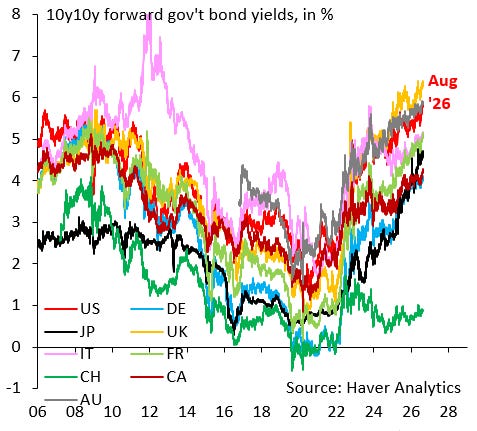

Thank you for subscribing to my posts. If you’re not yet a paying supporter, please consider becoming one. That’ll allow you to DM me with questions and comments. Your contribution will help cover the cost of the data I use in my posts, which I fund out of my own pocket. Thanks so much for your support and feedback! I wrote a post a week ago warning that the mood is shifting in global bond markets. Ever since COVID, fiscal policy has become unmoored across much of the G10, with budget deficits and debt issuance way higher than is the norm for a non-crisis period. Given that public debt is already so high for many countries, it’s only been a matter of time until markets run out of patience. It looks like that’s happening now. In my posts over the past year, I’ve focused on what’s going on with long-term yields as those are the best expression for how markets feel about debt. At the short end of the curve, interest rates are mostly an expression of how monetary policy is expected to evolve. It’s at the longer end of the curve that markets start to price risk premia and it’s here things are really moving. 10y10y forward bond yields – what markets price for the 10-year yield ten years from now – are rising all over the place, but they’re up most where the stock of debt is high and political dysfunction is acute. I fingered Japan as deeply distressed in Sunday’s live stream and an accompanying post . As it happens, Japan’s 10y10y forward yield is up most over the past ten days, followed by the UK, France and Italy. Markets are homing in on the most vulnerable places. There’s obviously the question what’s sparked this sell-off. The US yield curve has seen very pronounced bear-steepening since the last Fed meeting on July 29. That’s been dragging up long-term yields everywhere else. The latest spike in oil prices is also playing a role. Bonds don’t like instability and this is a reminder that the war in the Persian Gulf is completely unresolved. But this kind of finger-pointing misses the point in my opinion. When you have a lot of debt and run unsustainably large budget deficits, you’re extremely vulnerable to any old shock that comes along. It’s not about the shock, but – instead – the mess we are making of fiscal policy on a global scale. The chart above shows what’s going on with 10y10y forward yields. It shows the US (red), Germany (blue), Japan (black), the UK (orange), Italy (pink), France (light green), Switzerland (dark green), Canada (brown) and Australia (gray). Three points are worth making. First, long-term yields started rising in 2022 when central banks were hiking to reign in COVID inflation. That rise was driven by the front end of the yield curve, but that’s morphed into long-term yields rising autonomously. What’s happening now is all about risk and term premia, not monetary policy expectations. Second, countries with lots of debt and political dysfunction – like Japan, the UK and France – are being hit harder than others. Initial conditions turn out to be massively important. Third, the only outlier in all this is Switzerland and a handful of other low-debt countries. The benefits of responsible fiscal policy and things like Germany’s debt brake (that’s been hollowed out in recent years) have never been more apparent. The chart above zeros in on the past ten days. It shows the rise in 10y10y forward yields since August 7, so basically over the past week. Japan has been hit hardest – in line with my analysis on how broken its bond market is and big depreciation pressure on the Yen – while the UK, France and Italy are also getting hit. It’s clear that markets are differentiating and going hardest after those with pre-existing conditions. There’s great urgency for policy makers to get fiscal policy under control. Otherwise things will get a lot worse before they get better.Read More

Global Bond Markets Catch on Fire