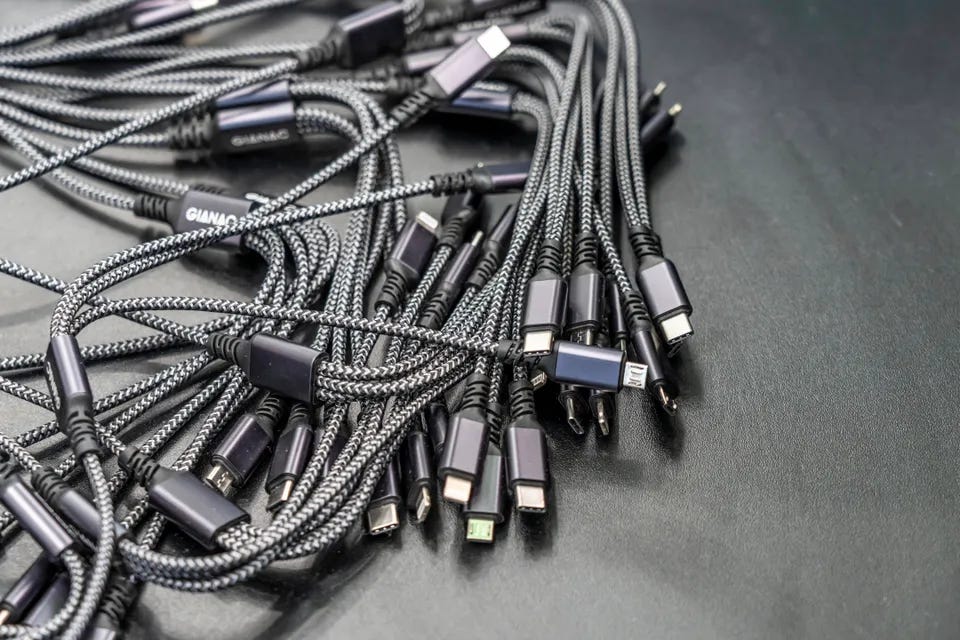

A column by Christian Stöcker It’s often the little things that drive us up the wall. The wrong charging cable in your luggage, for example. That’s why our house now holds a dozen of those multi-charging cables that combine a Lightning, a Micro-USB, and a USB-C connector. I’m looking forward to the day they all disappear. That day will come, because the European Union, as you may know, has decided that the new connector standard for the EU is USB-C. I personally love USB-C plugs for the same simple reason I once considered Apple’s Lightning connector a step in the right direction: they have no up or down. That’s applied usability. USB-C also saves money, because you no longer have to keep buying new charging cables and chargers. The EU estimates this spares us 250 million euros in spending per year. Christian Stöcker , born in 1973, is a cognitive psychologist and professor at the Hamburg University of Applied Sciences (HAW), where he heads the Digital Communication program and several research projects on the digital public sphere and disinformation. He previously headed the technology desk at SPIEGEL ONLINE. Phone manufacturers, Apple in particular, had tried to prevent USB-C for all, at times with grotesque arguments. That the EU refused to soften is a rare victory over US tech giants, one we all now benefit from. When Europeans grumble about “Brussels,” standards usually take the beating. An interesting aside: the EU’s so-called cucumber curvature regulation, which kept uninspired comedians supplied with material for years, hasn’t been in force since 2009. Many of the people who mocked it probably never noticed. Meanwhile, wholesale produce dealers continue to use the norms it laid down to sort their goods into quality grades. Voluntarily. Long live the standard. CE, Temu, and Shein There is a remarkable number of examples of successful European standards, from the globally respected CE markings (”Conformité Européenne”) for product safety to standards for chemicals, cosmetics, and the like. US manufacturers have long complied with them as well, because that’s easier than producing different variants for different markets. DER SPIEGEL – The German View is a reader-supported publication. To receive new posts and support our work, consider becoming a free or paid subscriber Subscribe The EU has just imposed penalties on the cut-rate online retailers Temu and Shein, because you can buy products there that don’t meet these standards. They may be toxic, dangerous, or simply useless. NDR, a German public broadcaster, once investigated this with test purchases, with astonishing results: “A string of lights and a charger posed a risk of electric shock. A smoothie maker offered no protection whatsoever against injury, a remote-controlled car door opener transmitted on a prohibited military frequency, and a smartwatch stood out for its unsecured data transmission.” Hardly any area of regulation reaches more people than consumer protection. An underrated treasure, and incidentally also an argument against anti-European parties like the far-right AfD. The “Brussels Effect” The fact that many manufacturers simply adopt EU rules wholesale rather than getting bogged down in product variants often allows “the EU to effectively dictate global product standards,” wrote the legal scholar Anu Bradford, a professor at Columbia Law School, in a 2015 study. Bradford went on to write a book about it, “The Brussels Effect.” These days you can sometimes get the impression that Brussels, and the federal government in Berlin too, have somewhat lost sight of this useful power. Yet we need it more than ever: “Standards are an indispensable tool for raising product safety and environmental performance. They can drive innovation, competitiveness, sustainability and consumer protection,” notes a 2020 publication by the independent European Policy Centre. Competitiveness! The EU is currently trying to win back its digital sovereignty with new rules. And indeed, there are areas where technical standards alone won’t be enough, for instance when cloud infrastructure sits in the United States, or when, possibly for legal reasons, it remains open to US authorities at any time even if the servers are located in Europe. Legal standards are needed as well. Data security, after all, is also an international competitive advantage. In many other areas, though, technical standards and reporting requirements are already an important step. US companies, for example, are currently pushing hard to keep the energy consumption of their data centers secret. That is a scandal, and it shows that the AI oligarchs from the United States cannot be trusted. When in doubt, the climate seems not to matter to them, as long as they win the grotesque bubble race currently underway. In the United States, investment in CO₂-emitting energy technology, gas turbines in particular, is rising again for the first time. Fortunately, things look different in the rest of the world. Europe must change direction again, and fast. If US corporations want to invest here, fine — but in clean energy, please. That, too, can be a standard: AI yes, but clean. Defending Europe’s Sovereignty Helps Everyone Europe’s market power has helped in the past to simplify things, guarantee safety, and keep negative developments in check. Standards are a necessary and simple lever for “defending” Europe’s sovereignty in the digital realm, and a particularly useful one for European companies competing in the market. Not least, they can counteract what the American author and digital activist Cory Doctorow has dubbed “enshittification”: US companies first offer a good product with good service at a good price, then, once a critical mass of customers is reached, make it progressively worse. First for consumers, then for business customers as well. In the final step, higher prices are charged for “premium versions.” All of this works mainly because switching platforms is usually so difficult. Standards can help there too. A positive example: I just set up a trial account with a new European music streaming service, following a “switching recipe” published by the Digital Independence Day initiative. That’s Real Freedom The best part of my test was how easy the move was. With a few clicks in a comfortable graphical interface, I was able to transfer all the digital albums I’d collected over the years, my self-curated playlists, and so on from Spotify to the new service. It worked so simply and smoothly that I could hardly believe it. Anyone who has ever tried to move from the toxic social media swamp of X to another platform knows how laborious that is. Simply reassembling your network somewhere new is usually anything but trivial. At best it works with external add-on tools that you have to grant far-reaching permissions, and even then only haltingly. Standards help there. Anyone Who Wants to Make Money Here Has to Play by the Rules For some time now there has been a technology initiative called EuroStack, whose stated goal is to “reverse the steep decline” that has turned Europe into a “digital colony” of the United States. One of its central demands: “harmonisation of standards.” A step in the right direction. This week, the people behind Digital Independence Day introduced another European initiative, the European Social Stack: “An ecosystem built on shared infrastructure and protocols empowers small builders to create social apps in no time and users to freely move between them.” Many companies, organizations, and operators have joined the initiative, including Fediverse applications like Mastodon and the YouTube alternative PeerTube, but also the environmentally friendly search engine Ecosia. The EU would do well to support such projects with everything it has, and perhaps to draw on them as the basis for future standardization. Quickly, too, because the standardization process and the adoption that follows often take too long. Shared infrastructure and shared protocols: that is exactly the kind of standardization a sovereign Europe of the future needs, and should confidently enforce. Standards exclude no one. But they set the rules of the game for companies that want to do business in one of the largest, wealthiest markets in the world. DER SPIEGEL – The German View is a reader-supported publication. To receive new posts and support our work, consider becoming a free or paid subscriber. SubscribeRead More
Standards Are Europe’s Best Weapon Against Big Tech