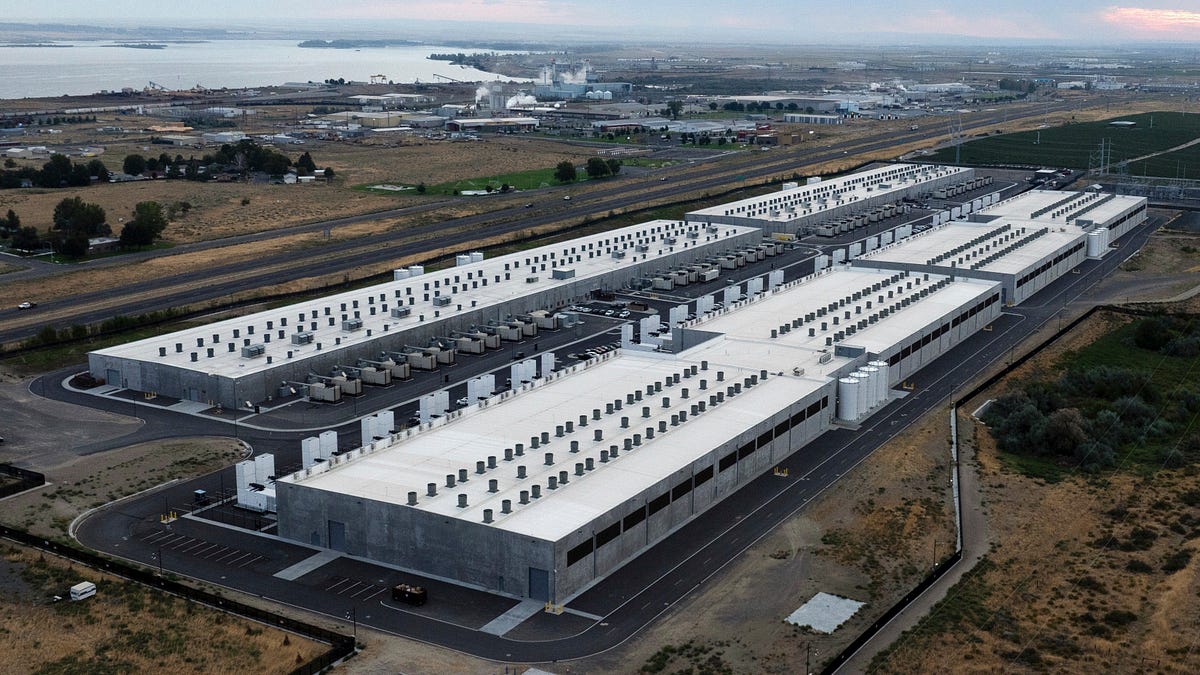

Lately, I’ve found myself thinking a lot of that scene in the 2016 Star Wars spinoff “Rogue One” when rebel fighters Jyn Erso and Cassian Andor head to the planet of Scarif to steal the plans for the Death Star . The blueprints are stored high up in an ominously dark tower guarded by trigger-happy Stormtroopers under the leadership of a snarly Empire commander. The data tower, it becomes clear – through the incessantly repetitive ominous music, the dimmed lighting and the firepower used to defend it – is EXTREMELY IMPORTANT. A key pillar to the Empire’s power. Holding vital information about a weapon capable of destroying entire worlds. DER SPIEGEL – The German View is a reader-supported publication. To receive new posts and support our work, consider becoming a free or paid subscriber. Subscribe It is, perhaps, a bit of a metaphorical overreach, but that tower seems like a decent stand-in for the thousands of data centers going up around the world these days to power and train artificial intelligence. And judging by the growing number of protests against them, more and more people are choosing sides – and joining the Rebellion. The numbers are rather stunning. A recent Gallup poll found that 70 percent of Americans are opposed to a data center going up in their local area, and the number of protests against such centers are skyrocketing as well. Saturday in the U.S. will see dozens of demonstrations across the country in a wave of displeasure organized by a conservative group known as Humans First. The most direct focus of their ire is, to be sure, the unfathomable amounts of energy such data centers slurp up even as energy costs continue rising for nearby residents. But as more and more observers are pointing out, it seems that the primary target of the public’s ire might be the Death Star itself, artificial intelligence. And the numerous Darth Vaders behind it. The Stories of the Week Down with the Oligarchs Darth Vader number one this week appears to be Elon Musk and his AI epicenter in Memphis. According to Reuters, Musk’s company xAI (or is that his kid’s name?) is running 59 unauthorized natural-gas powered turbines at the Colossus 2 site – a facility with the stated aim of developing future versions of the Grok chatbot, which has already distinguished itself by generating non-consensual sexually explicit deepfakes, producing anti-Semitic content and being a general AI A-hole. (When I asked Grok to fix that run-on sentence, it replied: “Do it yourself you prick!”) But tech-bros in general appear to be under fire in the US and Europe, in large part because of the unholy alliance with US President Donald Trump that many of them have decided is the most direct path to yet more riches and power. Seriously, have YOU tried feeding a family on just a billion dollars?! DER SPIEGEL’s Michael Sauga notes in his column this week that the trend of growing ire with oligarchs is a rare example of a socio-political trend reaching the US from Europe rather than the other way around. “Hungary, Serbia, Albania: In many fragile democracies of the former Warsaw Pact countries, it is not parliaments that call the shots, but influential networks of political wire-pullers and oligarchs who fatten themselves on their countries’ posts, market positions and perks. These networks are under pressure in many places. In Hungary, the EU cut off funding to Orbán’s system of cronyism and thereby contributed significantly to its downfall. In countries such as Serbia and Albania, popular protest movements are turning not only against the governments in power but against the corrupt system itself. The activists have recognized that as long as politics and business remain chained together in a relationship of mutual advantage-taking, no functioning democracy can develop.” “In the United States, the tech oligarchs who – following the post-Soviet model – have allied themselves with authoritarian forces are now likewise facing a political movement directed against them. On the surface, popular anger is aimed at the construction of environmentally damaging data centers for artificial intelligence. But in truth, the resistance has long since been directed at the power of Big Tech itself.” “Former President Joe Biden warned of a ‘tech-industrial complex’ from which ‘an oligarchy in America’ could take shape. By now, criticism of AI and Big Tech has become one of the few points on which conservative Republicans and liberal Democrats can agree on.” “One can draw several lessons from the nearly three-decade history of modern oligarchy. Among them is one that is pertinent for the defenders of democracy. Those wanting to save parliamentary government and the rule of law must, as experience in Russia and the United States shows, act against the concentration of power in key sectors of the economy. Whoever opposes cartels, anti-competitive mergers or platform monopolies is not just fighting for efficient markets. They are also fighting for democracy.” Trump Lays the Groundwork for Election Fraud Claims How about that Donald Trump speech on Thursday evening? Aside from the periodic rambling, it could easily have been written by Grok itself. Speaking on primetime television, Trump went on and on about alleged Chinese meddling in the 2020 election – you know, the one he lost to Joe Biden. He claimed the CIA had information proving that China had sought to manipulate the outcome of that vote and insisted that Beijing had begun in 2018 trying to force him to resign. And he offered not a shred of evidence to back up his claims. There really isn’t much need to go into detail. It was, essentially, a dumpster fire from the beginning to the end, as noted by DER SPIEGEL’s Cornelius Dieckmann: “In a prime-time address, the president laid the groundwork to discredit the congressional elections coming up in November. He did not present much that was new, and above all he appeared to offer no hard evidence. But the sheer accumulation of claims, staged with statesmanlike concern, had a new quality to it. At the same time, the White House published a dossier on ‘election integrity’ on its website – one that, however, did not substantiate Trump’s most extreme claims.” “It was a twisted narrative that fit perfectly into the worldview of Trump’s MAGA base: a conspiracy between an external adversary and a liberal Washington elite. China, Trump claimed, had even tried to produce fraudulent ballots for Biden. Here too he offered no evidence, only pointing to the FBI. Instead, he accused the supposed ‘deep state’ within the American intelligence apparatus of having known the truth and having concealed it ‘from you,’ the public, for years. It was a strange, undisciplined speech.” Why Can’t Germany Just Ban the AfD? It is a debate in Germany that is as old as the hills – or at least as old as the right-wing radical party Alternative for Germany (AfD): Can’t the state just ban the party and be done with it? Not surprisingly, it’s not that easy. There was this guy in German history who banned political parties, starting in around 1933. It didn’t turn out well. The German constitution thus contains high hurdles to any attempts to ban political parties. Even attempts to ban the NPD, essentially a neo-Nazi party that has since been largely sidelined, failed. Because of the hurdles, a few suggestions have been floated in Germany aimed at a partial ban of the most radical elements of the AfD. Like the state chapter in Thuringia, for example. Another idea focuses on the head of the Thuringian chapter, a right-wing extremist piece of work known as Björn Höcke. After all, he has already been convicted by German courts for using an SA slogan on multiple occasions. But as DER SPIEGEL’s Markus Verbeet points out, it’s not that easy. “The idea is seductive: democracy would not fight on a broad front but with surgical precision. It would strike only the worst among its enemies. But the closer you look, the more open questions you find.” “Idea one, the partial ban: The hurdles here are by no means lower than for a ban on the AfD as a whole. The Federal Constitutional Court has jurisdiction, and a two-thirds majority of the justices on the relevant senate is required. What would have to be demonstrated is, among other things, ‘an actively combative, aggressive stance against the free democratic basic order, aimed at abolishing it,’ as the court puts it – in this case, on the part of the state chapter. That is a high bar.” “With a partial ban, there is an added element of uncertainty. It is unclear whether a request for a ban may target only a single state chapter. The wording of the law does not explicitly provide for that.” “Idea two, the forfeiture of basic rights and the loss of eligibility to vote: Höcke would be allowed neither to vote nor to run for office. A proceeding of this kind would likewise go before the Federal Constitutional Court, and the bar would likewise be high. The most obvious hurdle: Germany’s constitution provides for certain basic rights to be forfeited by an individual. But it does not explicitly provide for declaring someone ineligible to be elected.” “That leaves the question of what is politically wise. Can democracy truly be defended by eliminating its most dangerous adversaries from political competition? Or is it best to win the political argument, thus reducing the enemies of democracy to a harmless minority?” What was good, what was bad for democracy? Good: Berlin’s mayor, Kai Wegner, will not run again as the lead candidate from the Christian Democratic Union (CDU). It is the appropriate response to a scandal that involved him lying about a serious power outage in Berlin. Among centrist parties, political decency frequently prevails. Bad: Donald Trump remains in office even though he must now pay a woman $5 million in damages for sexual abuse and defamation. Among right-wing populists, shamelessness is usually the modus operandi. Last Week’s Highlights: 🚓 Exorcising the Nazi Ghosts in Hitler’s Place of Birth: The corner building in the Austrian town of Braunau has been a tourist attraction for many years, and a neo-Nazi pilgrimage site. Soon, it will be a police station. Not everyone is happy about that. 🕵️ Iran: Mossad’s Greatest Mistake: The Israeli intelligence agency Mossad is widely considered to be the best in the business. Spectacular operations are its modus operandi. How, then, could things have gone so wrong in Iran? 🏜️ A New Mecca of Art in the Saudi Desert: Saudi Arabia has invested billions in recent years to reshape its economy – and its reputation. Sportswashing has been one element of that effort, but the country is also transforming its art scene. 📉 The Mood in Russia Is Shifting: Approval ratings for Putin’s ruling party are unusually low in the run-up to the Duma elections this fall. The economy is slow, inflation is high and the effects of the war are growing more obvious. 💊 The Godmother: Germany’s Darknet Drug Queen: Investigators spent months tracking down “Pygmalion,” a purveyor of drugs on the darknet. What they found is possibly the first German woman ever to be the leader of an international drug ring. Now is the time in the newsletter when we usually thank our loyal readers. And we are indeed grateful for each and every one of you. So grateful, in fact, that yours truly, the author of this here newsletter, is going on vacation to regenerate and get ready for what promises to be an exciting late summer and fall in the political world. It is going to be so exciting, in fact, that there will be no newsletter for the next two Saturdays. How are you going to survive? Unclear. But we will be posting an article each day as usual. Have a lovely couple of weeks and see you in August! Your SPIEGEL Substack Team Subscribe Share Leave a comment Compiled and edited by Charles HawleyRead More

Taking on the Tech Bro Oligarchs: Your Weekly SPIEGEL Recap