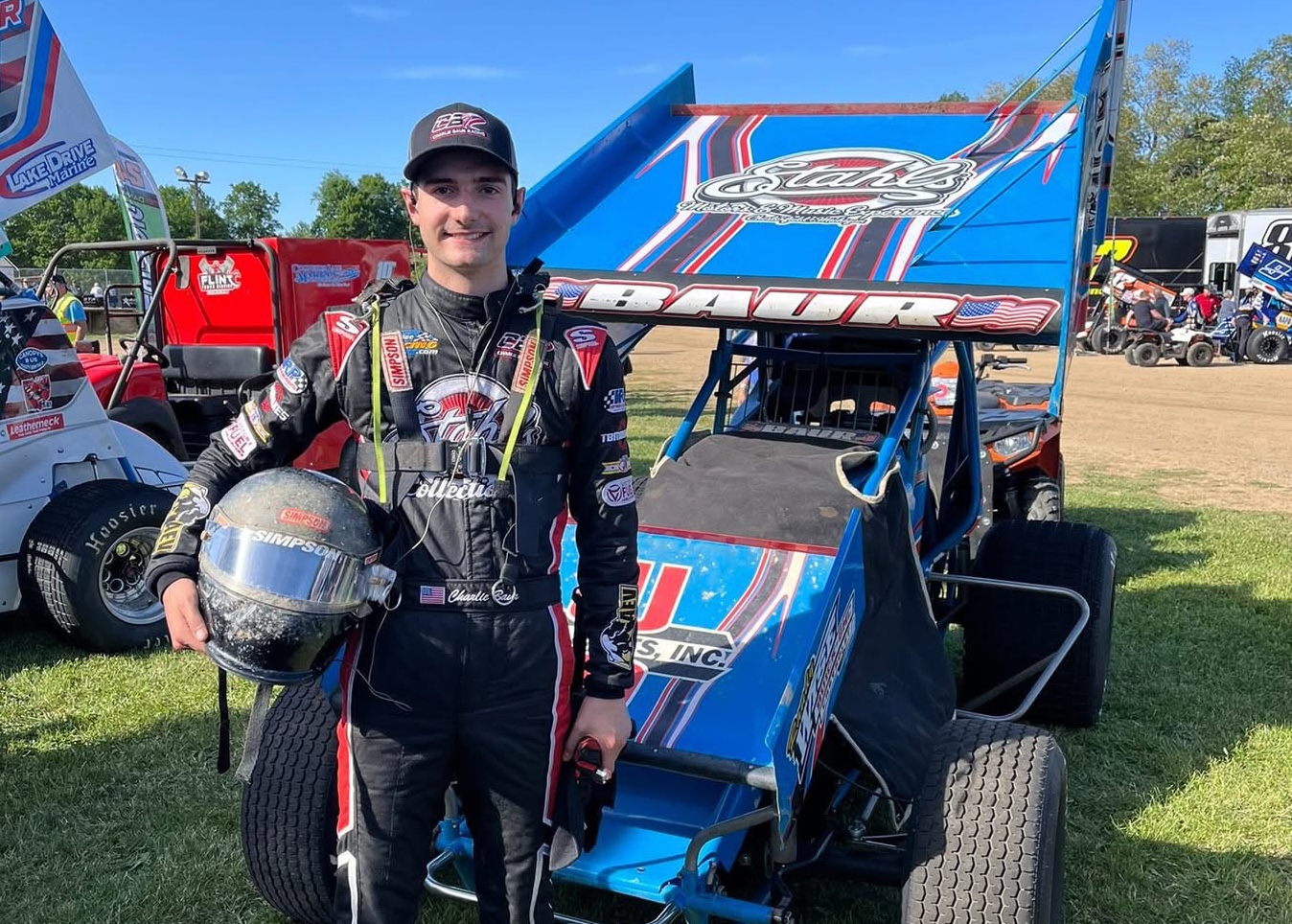

Charlie Baur can trace his racing story back to a Christmas morning in Michigan — the kind that starts with snow on the ground and ends with a throttle in a kid’s hands. “I remember being 3 years old and then for Christmas that year, my parents had gotten me a 120 cc snowmobile,” Baur said. Long before sprint cars, he was a Michigan kid on snowmobiles, dirt bikes, four-wheelers and jet skis — and a regular at car shows and races with his family. Photo courtesy of Charlie Baur That early exposure became a calling. At 12, he sat in a sprint car for the first time and knew he’d found the next chapter. He started in quarter midgets, moved to go-karts, and the day before he turned 16 — one day shy of the minimum age required by track insurance — he made his first sprint car start after convincing officials to let him race. Five years later, Baur is still pushing forward, now racing sprint cars on both pavement and dirt while pursuing an automotive business education at Northwood University — with a clear-eyed understanding that motorsports encompasses more than what happens under the lights on Saturday night. “It’s a business,” said Charlie, a 20-year-old who calls Fenton, Michigan, home when he’s not at a racetrack or at Northwood’s residential campus in Midland, Michigan. Photo courtesy of Charlie Baur Racing is the product — but preparation is the job To the average fan, race day begins around dinner time. For a team, race day can be a 12-hour shift — plus the work that came before it. And Baur’s racing operation is a family affair. “The team is my parents and myself,” he said, explaining they own the cars, maintain equipment and manage the business side — from sponsor relations to budgeting. On race weekends, the core group includes Baur and his parents (Eric and Stefanie), plus a couple of additional hands (Alex Photiou and Robert Flannigan) who help with the intensity and pace of trackside work. That structure has shaped how he thinks about efficiency and professionalism. “We’ve always kind of had the mentality of we’re never working on the car for maintenance at the track,” he said. “Our goal is to do as little work as possible to the car because it should be ready when that car rolls out of the trailer to go racing.” That mindset shows up in routines: bolt checks, tire procedures, safety equipment and a repeatable process designed to limit errors. “Once I fire the car up and put my helmet on, that’s when it’s go time,” he said. “You can plan as much as possible for how the race is going to play out, but until you take the green flag … you don’t know how it’s going to go.” Photo courtesy of Charlie Baur First-generation driver, student of the game In racing, “first-generation” matters — and Baur wears that label with pride. “A lot of the drivers are third or fourth generation,” he said. “My family has never been in motorsports. So for me, we’ve always looked at it as we’re new to it and we want to be as different as possible. From a marketing standpoint, it helps us stand out.” It also pushes him to seek out mentors — especially veteran drivers who have seen every scenario, solved every problem and won in multiple eras. Baur credits accomplished driver Jason Blonde, a 10-time champion, for becoming his driver coach and helping him develop as a competitor. “To me, learning from Jason helps me because he has had lots of success and knows what to do,” Baur said. “You have to humble yourself and say, ‘I don’t know what to do; can you help me out?’” That willingness to learn extends off the track, too. Baur says one of his biggest challenges is not a mechanical limitation, but credibility. “It’s my age,” he said. “Some people won’t take me seriously because I’m so young. Even though … I do know what we’re talking about and have a general idea.” His answer has been to out-prepare, out-communicate and treat the operation like a real enterprise — because it is. Photo courtesy of Charlie Baur Northwood’s role: Turning passion into a plan Baur is majoring in automotive aftermarket management and pursuing an accelerated path that pairs undergraduate study with graduate work. He’s also exploring how to align his studies with motorsports-focused coursework as Northwood advances related programs and pathways. He sees the value clearly: motorsports needs business-literate professionals who understand budgets, sponsorship, marketing, operations and long-term strategy — and who can translate between the language of the shop and the language of the boardroom. That’s why his Northwood experience isn’t limited to the classroom. He has been involved with the Northwood University International Auto Show and serves as motorsports chair — a leadership role that demands outreach, contracts, coordination and a steady professional demeanor. “There’s so much outside work that makes the auto show successful that people don’t realize,” he said. “And it is truly student led.” He’s also participated in industry experiences through Northwood at major events such as AAPEX, SEMA and PRI, along with other automotive networking events — opportunities he describes as a fast track to understanding how business really gets done. “You learn a lot in the classroom,” he said. “But if you learn it and you can’t apply it to the real world, it loses its value. Or if you learn it and can apply it, but you don’t know anyone, it is still of no value.” In his words, Northwood helps him win because it “gives me the tools to succeed” — including flexibility and faculty support as he balances travel and racing commitments with academics. Photo courtesy of Charlie Baur Racing as an ecosystem — and a talent gap waiting to be filled Baur is blunt about what he sees across the motorsports world: a deep bench of experienced professionals, and not enough young talent entering the pipeline. “I go to car shows, I go to these different events, and typically … the average age is between 45 to 55,” he said. “There’s not a lot of young people going into the motorsports world.” That reality reinforces Northwood’s communications focus: positioning motorsports not as a narrow lane, but as a wide ecosystem of business careers — sponsorship, logistics, data, media, leadership, hospitality and innovation — with real demand for prepared graduates. It also shapes how Baur talks to younger students who love racing but aren’t sure what their future looks like. “If you have a passion for motorsports, there’s gonna be a spot for you somewhere,” he said, emphasizing that driving is only one of many career paths — and that local tracks and hands-on experience are often the best first step. But if someone is interested in driving as a career path, it will take a team to make that happen. Baur’s team includes Stahl’s Motors and Music Experience, Rhino Racing, Randy Wise Buick GMC Chevrolet, Western Michigan Fleet Parts, Mother’s Polish, Schaeffer’s Oil, Hepfner Racing Products, Ameriguard Storage Centers, Justice Brothers, Race 1 Wraps, TBM Brakes, Behind Your Design, CharlieBaur.com and Northwood University. “There are so many people who invest not only in myself but in my race team and who believe in us to succeed,” he added. Pictured: Charlie Bauer’s sprint race car. Looking ahead: A headline worth chasing Ask Baur to imagine 2035, and he’ll give you two answers — one dream, one blueprint. “In a perfect world,” he said, “winning the Indy 500.” Realistically, he wants to build a life where business ownership and racing reinforce each other and where he can pay forward the help he has received by mentoring younger drivers, especially those trying to break into motorsports without a family legacy. “When I retire from full-time racing, I want to be able to provide the same opportunities that were presented to myself to the next generation of drivers,” Baur said. “I know how difficult it is to get your foot in the door.” For now, the focus is simple: keep building the operation, keep learning the business, and keep showing up prepared — because in sprint car racing, as in life, process matters. And once the helmet goes on? “It’s go time,” Baur said. Photo courtesy of Charlie Baur Learn more Students interested in motorsports careers — whether in competition, team operations, marketing, finance, sponsorship, data, or management — can explore opportunities through Northwood University’s Center for Automotive and Mobility Studies. For Charlie Baur’s latest motorsports adventures, follow Charlie_Baur and Charlie Baur Racing on social media. To learn more about Northwood’s Bachelor of Business Administration in Automotive and Mobility Studies and motorsports management concentration, visit www.northwood.edu/programs/automotive-mobility-studies/. Photo courtesy of Charlie Baur Pictured: Charlie Baur at Butler Motor Speedway on May 31, 2026. Share this pageRead More

From Classroom to Racetrack: How Charlie Baur is Building a Motorsports Career in a Business Discipline