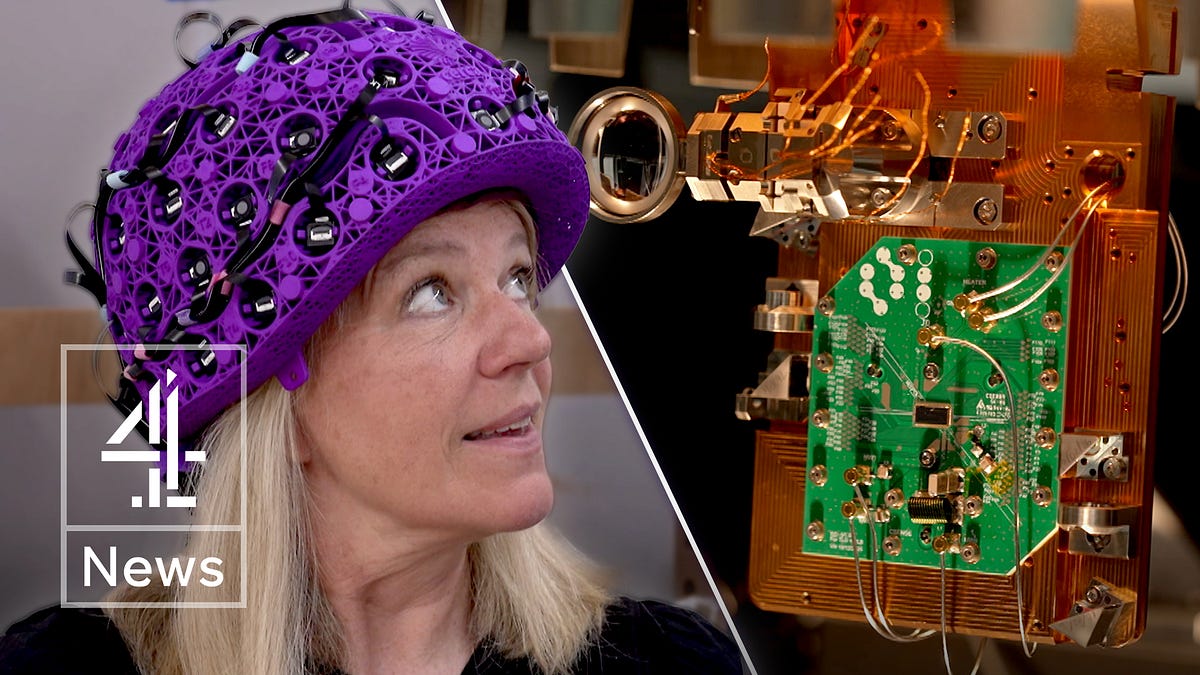

If President Trump’s Air Force One guest list to China highlighted anything, it was the projection of US power through technological strength. Subscribe Think Tim Cook, the Apple boss, Elon Musk and in particular the last minute inclusion of the billionaire Jensen Huang, the chief executive of Nvidia – the world’s biggest AI chip maker. There’s no doubt attaining AI supremacy is THE global tech race – one that the US is desperate for China not to win. Because whoever wins could hold the balance of power militarily, economically and politically. But there’s another less well-publicised battle going on at the same time; one that China is also quietly pumping billions into. And that’s harnessing the power of Quantum. What is Quantum technology? Quantum is an emerging technology that mirrors the science of the universe; the mechanics that run our world at the atomic level. It turns out the way atoms move produces more power than anything else on earth, if it can be captured and scaled in a reliable, fault-tolerant way. That’s what scientists the world over are rushing to achieve; while governments are doing all they can to help them get there. Because, just like AI, Quantum is seen as critical for economic and national security. [ ]( https://channel4news.substack.com/p/nvidia-why-trump-has-lifted-americas ) [ Nvidia: Why Trump has lifted America’s ban on selling AI chips to China ]( https://channel4news.substack.com/p/nvidia-why-trump-has-lifted-americas ) Lindsey Hilsum · December 9, 2025 [ Read full story ]( https://channel4news.substack.com/p/nvidia-why-trump-has-lifted-americas ) Witness today, with the White House set to announce $2 billion in grants for the sector, as well as the US government taking ownership stakes in a number of Quantum firms. The British government is placing massive bets on Quantum too, believing the UK has a serious advantage that it’s desperate to retain. How does Quantum work? So, how does it work? Well, picture a maze. To get from one side to the other, standard – so-called classical – computers have to try every route to solve the problem. When one pathway doesn’t work, they try another and another until they’ve cracked it. Classical computers operate using bits, which represent information as either 0s or 1s. But Quantum technology does something completely different. Instead of bits, it uses Qubits – atomic particles – which can be either 0 or 1 or both at the same time; a scientific phenomenon known as “superposition”. It’s this that gives Quantum all of its power. In our maze example, it means Quantum technology can scan every path simultaneously so it finds the correct route out of the maze almost immediately. In other words, for problems that would take today’s most powerful computers years to solve, scientists say a Quantum computer could solve in a matter of hours. The race in China China is already using Quantum technology to create ultra-secure communication links between big cities that are theoretically impossible to intercept. Ideal for military and government security and financial infrastructure. But this is only one application. Quantum sensors have already demonstrated significant breakthroughs in medical imaging, but could also revolutionise submarine detection, navigation systems and underground mapping – all critical for military planning. What about the UK? Here in the UK, we visited a company in Oxford, spun out of the university, that’s using Quantum technology to develop a new generation of super-fast computers – ideal for things like complex supply chain planning and drug discovery, where multiple potential outcomes can be tested and filtered quickly to reach the best result. It’s benefited from years of government funding and support for start-ups. Earlier this year, Chancellor Rachel Reeves announced a further £2 billion in Quantum funding to help supercharge the sector and keep the UK at the cutting edge. The company, Oxford Ionics, is the brainchild of PhD physicist Chris Ballance and his partner, who together spent years working out a way to convert the complex science of Quantum mechanics into an actual scaleable, commercial product. They are one of the poster childs of the government’s high-tech Oxford Cambridge growth corridor, but they were so far ahead – their product so innovative – that the company was snapped up by a big American rival, for just over $1 billion. [ ]( https://channel4news.substack.com/p/inside-anthropics-battle-with-the ) [ Inside Anthropic’s battle with the Pentagon ]( https://channel4news.substack.com/p/inside-anthropics-battle-with-the ) Siobhan Kennedy · Mar 11 [ Read full story ]( https://channel4news.substack.com/p/inside-anthropics-battle-with-the ) Of course, on one level, this is fantastic news for the UK; a British hi-tech firm being subsumed into a larger, listed American rival can only help it grow and become a world-class leader. That’s how Dr Ballance, pictured below , sees it. He says he will remain in the UK and the injection of cash will be used to add dozens of highly-skilled science and manufacturing jobs. The perennial UK problem But it does also highlight the perennial UK problem. We have the talent in this country and early-stage investment for start-ups is readily available. What’s harder to secure is late-stage funding. The bigger cheques that represent significant bets on small businesses, but which are absolutely critical to allow them to take the next big leap onto the global stage. That’s what it takes to create a “national champion” around which will gradually coalesce an ecosystem that eventually gives rise to genuine economic growth and some bang for the Chancellor’s bucks. The ‘Google equivalent in Quantum’ It is clear that the promise of Quantum is an opportunity for the UK government to achieve precisely that. So, is it disappointing that the first big success story to emerge from Oxford has already been gobbled up by an American firm? A firm whose boss proudly told us the combined entity could conceivably become the first trillion dollar Quantum company in the years to come. Science Minister Lord Vallance admits it is disappointing, but he insists there’s still everything to play for. “Do I want to have the Google equivalent in Quantum? Yes, I do. There’s no reason why we can’t do that. We’ve got the right skills, we’ve got the right start-ups and of course this becomes an export opportunity if we get this right.” For his sake and the sake of the British economy, let’s hope the UK does get it right this time. Having been left behind on AI, let’s hope we manage to retain our leadership in Quantum, to nurture and grow it, then sit back and reap the rewards. The race is on. Subscribe Share Channel 4 News Leave a commentRead More

Quantum: Inside the lesser-known global tech race