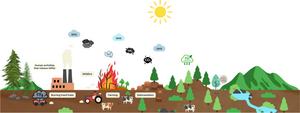
Forest ecosystems stand as indispensable regulators of the planet’s climate, actively influencing atmospheric greenhouse gas (GHG) emissions and thereby affecting global warming. A recent study by researchers at the University of Debrecen provides a comprehensive evaluation of these emissions from various sources within forested landscapes. The investigation assesses their individual contributions to global warming potential (GWP), delivering crucial insights for shaping climate policies, advancing carbon accounting, and implementing sustainable forest management practices. This work is essential for developing more precise strategies to mitigate climate change and deepening our scientific understanding of ecosystem-climate dynamics. To achieve its objectives, the research employed a rigorous analytical framework, utilizing comprehensive data from the EDGAR—Emissions Database for Global Atmospheric Research, spanning from 1990 to 2022. This extensive dataset enabled the team to meticulously analyze emissions of carbon dioxide (CO₂), methane (CH₄), and nitrous oxide (N₂O) originating from deforestation, forest fires, and natural processes such as organic soil decomposition. The study leveraged time series analysis and an ARIMA model to identify trends, project emission trajectories until 2030, and quantify CO₂ equivalent emissions for each category. Further, correlation analysis illuminated the intricate relationships between various emission sources, offering a holistic perspective on terrestrial carbon dynamics.Read More

New research quantifies forest ecosystems’ dual role in global warming, offering urgent path to carbon neutrality
 By EurekAlert!