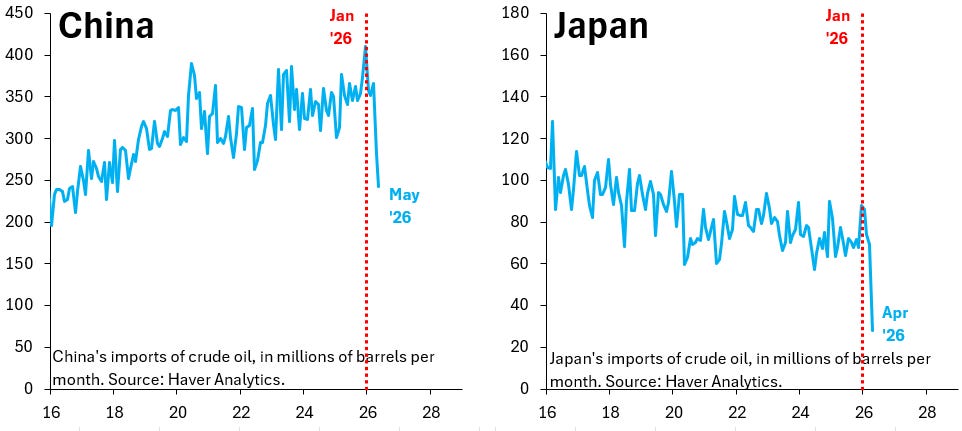

Thank you for subscribing to my posts. If you’re not yet a paying subscriber, please consider becoming one. That’ll allow you to DM me with questions and comments. I plan to move my posts behind a paywall in coming months. Subscribing now locks you in at a low rate. Thank you so much for your support and feedback! There’s two arguments oil bulls give for why prices didn’t spike much higher. The first is market manipulation, i.e. the US government was intervening in futures markets to artificially cap prices. There’s no evidence of this. It’s wrong. The second is that China made an active decision to import less and draw down inventories in order to stabilize global oil markets. That’s also wrong and – frankly – comically so. China’s imports fell because the Strait of Hormuz was closed and the US was blockading Iran. The drop in its crude inventories is just a reflection of that. China was scrambling for oil just like everybody else in Asia. It was no “stabilizer.” This “China-as-stabilizer” narrative is so galling for two reasons. First, you just have to look at what happened to other countries’ imports to disprove it, which isn’t exactly a high bar. That’s what I do in today’s post. Japan’s imports fell by more than China’s in this shock. If China had wanted to stabilize markets, you’d think it’d be the other way around given its huge inventories. Second, China has become Russia’s biggest trading partner since the Ukraine invasion. It’s the only reason Putin is able to keep fighting in Ukraine. There’s nothing remotely “stabilizing” about China. The opposite is true. The reason I care strongly about this is because it’s important to be clear about why oil prices didn’t go to $200. They didn’t because – as I explained yesterday – they never needed to. As I said back in March and discussed with Paul Krugman on his podcast , standard price elasticities of demand suggest oil prices only needed to rise to $125, so $200 was never in the cards. It’s that simple. No need for conspiracy theories on the futures market or misguided stories about China as a “benevolent” actor. This matters because I want the West to be much more forceful on Russia. Given what we’ve learned in recent months, I’d love to see a full blockade of Russia in the Baltic – just like for Iran – but I’ll settle for aggressively shutting down its shadow fleet . Neither is likely to spike global oil prices wildly, but this will hurt Russia. The two charts above show monthly imports of crude in millions of barrels by China (left) and Japan (right). There’s a big drop in Chinese import volumes of crude in April (84 million barrels), which is far bigger than that for Japan (41 million barrels). But this difference in scale is a simple reflection of the fact that China’s economy is four times as big as Japan. If you want to get a sense of China’s intentions, you need to look at import volumes on a standardized basis for both. That’s what I do next. The two charts above normalize these data to be 100 on average in 2025 for China and Japan. This highlights that Japan’s imports fell far more sharply (57 percentage points) than for China (24 percentage points) in April. If China had been trying to stabilize oil prices, you’d expect to see the opposite, i.e. China ramping down imports harder given its huge inventories. The bottom line is that China’s imports fell not because of some kind of benevolent action, but because the Strait of Hormuz was closed, which pulled down imports for many other countries too, including Japan. There’s nothing special about China in this shock. The “China-as-stabilizer” narrative is almost comically wrong. China’s import fell because the Strait of Hormuz was closed and the US blockaded Iran. That’s also why its inventories fell. China was scrambling for oil just like everyone else in Asia. This means oil prices stabilized all on their own. Price elasticities did that, not China. The US showed the way on how to impose a blockade in this shock. Europe should now do the same to Russia. If not an outright blockade, then it should go after the shadow fleet aggressively. We’ve just learned that the effect on oil prices will be modest.Read More

China did NOT cap global oil prices