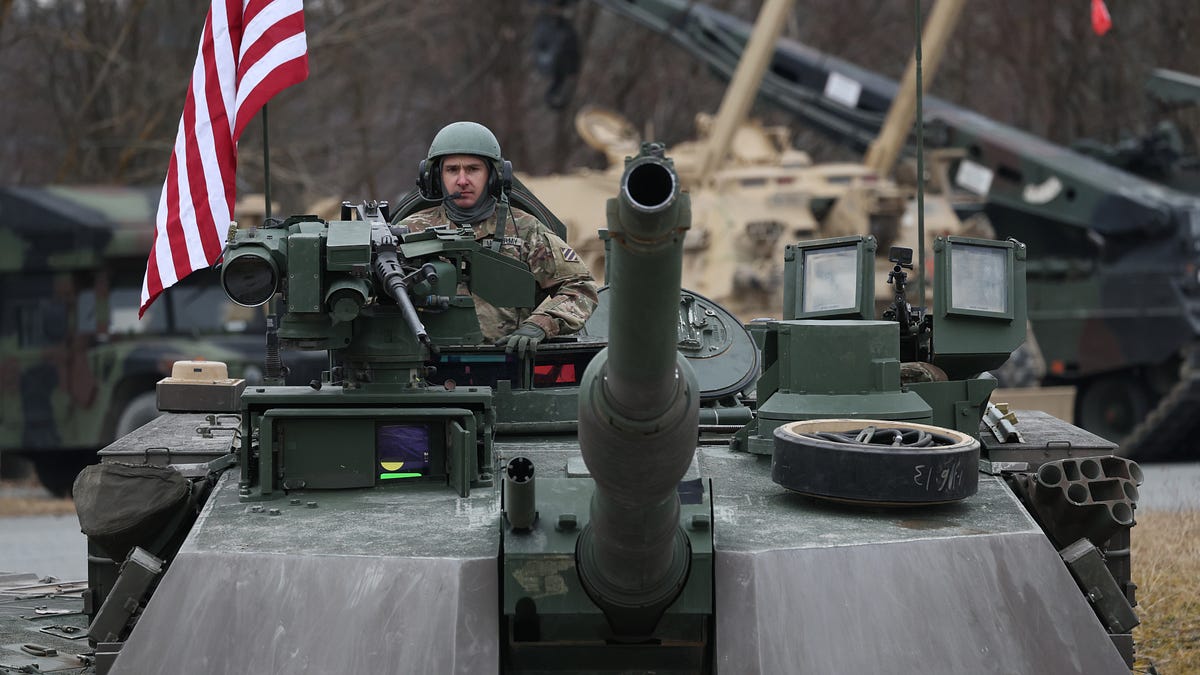

ONE OF THE BIGGEST MISTAKES of my career wasn’t something I did. It was something I failed to prevent. I was commander of U.S. Army Europe in the early 2010s when U.S. forces were being drawn down in the European theater. I argued—forcefully, with member of Congress, the administration and the Department of Defense, and even my military commanders—that we shouldn’t do it. In the final throes of the discussion, I pleaded to keep just one more tank brigade combat team on the continent. Those tanks, armored vehicles, and supporting forces would have signaled not to our allies but to our foe, Putin, presence and commitment. I believed then, as I do now, that removing that force created an opportunity for Russia to test the NATO alliance and to pursue its longstanding objective of expanding its influence. I wasn’t persuasive enough. My arguments fell on deaf ears, and the brigade’s soldiers were ordered to return to the United States. Not long after, Russia seized Crimea and invaded Ukraine’s Donbas region. I won’t claim that the decisions of those who were my superiors caused that aggression—but I believe it contributed to it. I remember a warning from the then-president of Georgia, Mikheil Saakashvili, who told me plainly that if we pulled that kind of capability out of Europe, Moscow would act. He was right. I still question myself as to how I could have been more persuasive. On Friday night, when I heard that Secretary of Defense Pete Hegseth announced a reduction of 5,000 U.S. troops in Europe based on what he called a “thorough review”—but more likely because of the desire of President Donald Trump’s retribution against German Chancellor Friedrich Merz for his recent comments about the war in Iran—I hear an echo of the argument from more than a decade ago. And I worry we are about to make an even bigger mistake. Don’t just read the news. Join a community where we help each other be the best citizens we can be. Become a Bulwark+ member. Join I WOULD LIKE TO SEE the Department of Defense’s “thorough review.” Because I was part of a similar one conducted over a decade ago. I helped plan and later execute the last major transformation of U.S. Army forces in Europe—one that took that force from 90,000 troops to about 34,000 between 2004 and 2012. That wasn’t a decision made quickly or casually. It took years of analysis, coordination, and constant negotiation across governments, services, and commands. It required aligning troop movements with deployments to Iraq and Afghanistan to avoid tearing apart families and units. It involved extensive consultation with host nations such as Germany and Italy, where political, legal, and economic considerations were as important as military considerations. It required detailed planning for base closures, infrastructure consolidation, and a plan for a strategic long-term presence on the continent. It also took unique action to ensure families of those forces were treated well as we hurried their return to the United States in massive waves of base and housing closures. The planning and the execution were phased deliberately, executed carefully, and constantly reassessed. Those are the kinds of procedures and actions that constitute a real, “thorough review.” I don’t believe for a second that there was anything like that kind of process before the withdrawal announcement made yesterday evening. This decision does not bear the hallmarks of a plan that resulted from careful thought, deliberation, consultation, and diplomacy. It reflects a misunderstanding of what U.S. forces in Europe are and what they do to contribute to the security of both the United States and our European allies. There is a persistent myth that Europe hosts a large, excess pool of American troops—most of them sitting in Germany, eating schnitzel and drinking beer, waiting for something to do. That’s simply not true. The current force is relatively small, but it is deliberately structured, balanced, and distributed across the continent to achieve specific strategic effects. The units and headquarters in Germany are part of a larger network stretching from Norway to Italy, from Spain to Poland, from Romania to the Baltics—with each location tied to a particular and coordinated mission. Naval forces operate from key bases in Spain and Italy, ensuring maritime security in the Mediterranean and beyond. Air Force units fly from massive installations in Germany, Italy, and Spain, providing rapid-response capability across multiple theaters. Marine Corps elements maintain crisis response forces positioned to move quickly into the Arctic, Africa, or the Middle East. Germany houses critical intelligence centers, logistics hubs, maintenance facilities, and command-and-control headquarters that underpin global operations. Special Operations Forces maintain a steady eye on terrorist networks, and cybersecurity personnel work with partners to protect our networks against intrusion. Facilities like Landstuhl Regional Medical Center provide critical medical support for operations in the Middle East and Africa, as well as care for diplomats and others stationed in 49 countries in Europe, 54 countries in Africa, and a bevy of countries in the Middle East. When you remove 5,000 troops from an interconnected system like that, you are not simply reducing numbers—you are exponentially degrading U.S. strategic capabilities. Those troops are not infantrymen with rifles sitting around making Germans feel safe. They include intelligence analysts who track adversary movements and provide early warning. They include cyber operators defending networks and conducting operations in a contested digital environment. They include military and civilian logisticians who ensure that equipment, fuel, and supplies are maintained and moved where they are needed, when they are needed, across three continents. They include aviation crews who operate the airfields that enable rapid deployment and provide support for government officials on diplomatic missions. They include medical personnel whose work extends far beyond the battlefield. Pulling out an arbitrary number of 5,000 of them creates gaps. And gaps in a system like this don’t remain isolated—they cascade. Join There are also costs—real costs—that rarely enter the conversation. In those early years of this century, we invested billions of dollars in congressionally allocated funds as part of a long-term plan to modernize facilities across Europe. Before 2003, many of the barracks, dining facilities, and workspaces used by American troops were relics of World War II—structures originally built for German forces. Over the past two decades, those have been replaced with modern infrastructure designed for long-term use at five major hubs (down from the more than seventy locations that hosted American forces during the Cold War). That investment was not made with the expectation that we would leave; rather, it was made because we believed Europe would remain central to American global strategy. To reduce forces now without accounting for those investments is pure fiscal negligence. When we reduced forces in the early 2000s, we didn’t simply close bases and walk away. European labor laws required the transfer of facilities, environmental sweeps, and in many places forced us to continue paying host-nation employees—often for a year or more—after facilities were shuttered due to local labor laws and our international agreements. And beyond all the financial implications lies something even more important: access. One of the most significant advantages of U.S. forces in Europe is their role as a forward-positioned platform—a “lily pad” that allows the United States to respond rapidly to crises far beyond the continent itself. From Europe, we are an ocean closer to supporting operations in the Middle East. We are able to respond to instability in North Africa and the Middle East, and maintain presence in regions where permanent basing would be politically or logistically difficult. Airfields, ports, and logistics hubs across Europe provide flexibility that cannot be replicated from the continental United States. Reduce that presence, divest from those partnerships, and it’s not just Europe that feels the pinch—America does too. Share WAR AND PEACE CANNOT BE REDUCED to double-entry bookkeeping or numbers of soldiers assigned to a location. America’s strength rests on alliances, and those alliances are built on trust, shared risk, and consistent presence. When the United States reduces its footprint without clear strategic justification—or without meaningful consultation—it sends a signal. Allies question American commitment. Adversaries begin to test it. And trust is not something that can be deployed; it is built over time and with meaningful engagements. We have seen elements of all this before. Reductions in presence lead to reductions in influence. Reductions in influence weaken deterrence. And weakened deterrence invites opportunistic behavior from adversaries. This is not theory; it is an expected and repeatedly proven pattern. As someone who spent years working alongside allied forces across Europe—training together, planning together, building the relationships that make coalition operations possible—I can state unequivocally that those partnerships do not sustain themselves automatically. They require presence. They require engagement. They require a visible and credible commitment. Alliances are hard to build and easy to break. Civilian leaders have every right—and responsibility—to shape military posture. But those decisions must be informed by a clear understanding of how the force works. Decisions of this magnitude must account for second- and third-order effects, and they must recognize that military systems are interconnected, and that seemingly small changes can produce outsized consequences. Every day, I still think that back in the 2010s, a single U.S. armored brigade—coincidentally a unit of about 5,000 soldiers—may have prevented the first Russian invasion of Ukraine and the devastating war that followed. A real “thorough review” would weigh not just costs, but capabilities, diplomatic effects, and tomorrow’s strategic risks. You can’t convince me any of these considerations were present in the review Secretary Hegseth mentioned; it doesn’t pass the common sense test. What I see instead in the order withdrawing 5,000 troops from Germany is a decision that treats a complex, carefully constructed force deployed far from the United States as if it were a simple number to be adjusted. It has all the hallmarks of a decision made by a petulant senior leader looking for short-term retribution regardless of long-term strategy. And I see echoes of a previous mistake—which I believe contributed to instability in Europe and which I wish I had done more to prevent. When I commanded U.S. Army Europe, I often said that our relatively small force allowed us to “fight above our weight class.” That was not a slogan. It was a recognition that presence, positioning, and partnership multiply power in ways that raw numbers cannot capture. Reducing that force without a clear strategy does the opposite. It diminishes power in ways that may not be immediately visible—but will become clear, and counterproductive, over time. I have seen what happens when we underestimate those effects. And I don’t believe we can afford to learn that lesson again. ShareRead More

The Last Time We Reduced Troops in Europe, a War Broke Out