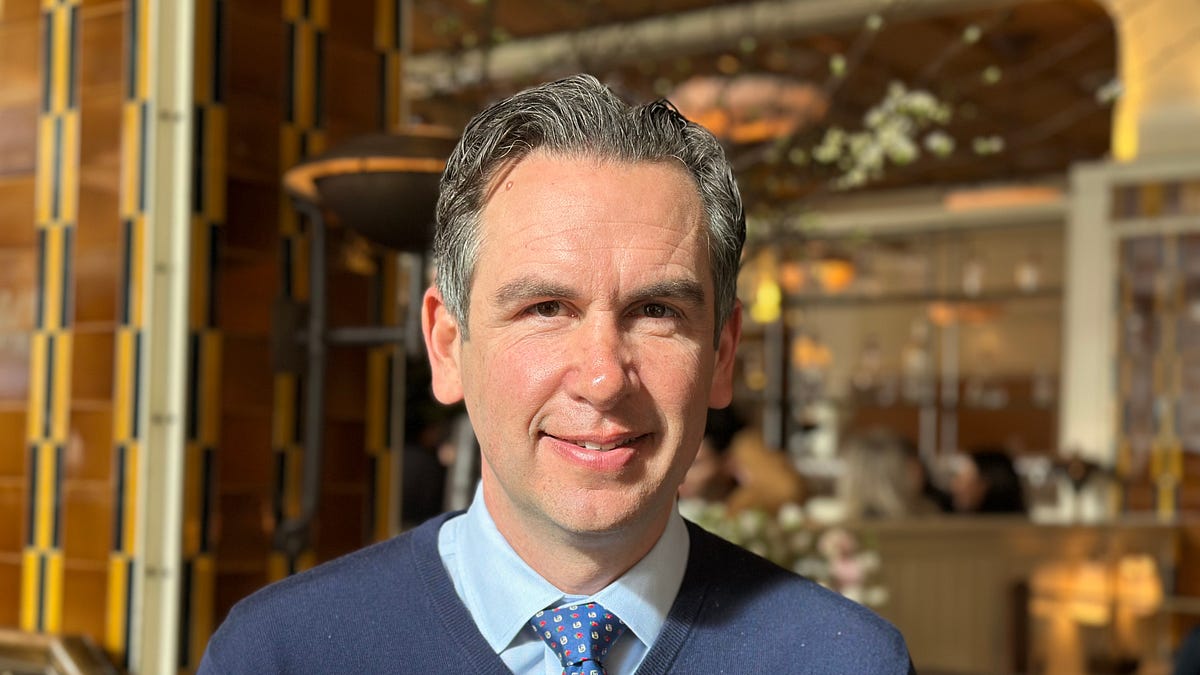

Steven Fulop, the new President and CEO of the Partnership for New York City, the city’s leading big business advocacy group, spoke with The New York Editorial Board on the morning of March 19, 2026. Fulop recently began in the role after 12 years as mayor of Jersey City and a 2025 run for governor of New Jersey. He replaced longtime Partnership President/CEO Kathryn Wylde. (photo by Liena Žagare) Participating journalists: Nicole Gelinas, Josh Greenman, Alyssa Katz, Ben Max, Akash Mehta, Harry Siegel, Ben Smith, Liena Žagare Full Transcript **Ben Max **Good morning. Thanks for being here. So start us off: The people who hired you for this role, what did they make clear were their top priorities for you coming into it, and for the Partnership, and what did you sort-of pitch as the direction you thought things could go? Give us a little of that bifurcation of where the minds met in terms of the priorities and the leadership for the new era. **Steven Fulop **Let me explain to you how I ended up in the job, OK? That’s probably a good starting point, because I don’t think anybody initially thought that I was the pick that they coveted or thought that would be an ideal fit for this position. I’d run for [New Jersey] governor, as you guys know, and I was very deliberate in the lane that I was taking as a candidate for governor. The same candidate when I ran for mayor and city council — it was outside the establishment. It was building on issues, single-issue voters — very, very concentrated on detailed policy. And I thought that if I could build an organization, outside of the typical political organization, of single-issue voters, you could become viable because they’re passionate people generally, OK? And one is mayor, outside the establishment doing that. You won two races in the country that Obama actually engaged in as president. Rahm Emanuel and Jeremiah Healy, my predecessor, was a ten-year incumbent. So we won based on this structure. Run for governor, kind of in that same model. And I thought at the time that 550,000 people would turn out in the election. That was based on history in a similar election, when Chris Christie left and it was Trump’s first-year primary, you know, changeover in governor. There was five hundred or four eighty-seven [thousand]. So I thought five-fifty was a bump up. Same numbers Sherrill had, Ras Baraka had. I thought five hundred and fifty thousand people in the election, six candidates running that are viable — two congresspeople, two mayors, senate president, and the teachers’ union president — that if I got to a hundred and thirty thousand votes, single-issue passionate voters, I would get in through the primary with twenty, twenty-five percent, and then put it back together even though I was kind of the outside establishment guy. I think I did everything perfect during that election, OK? With the exception of winning. Which is the big deal. But I miscalculated one thing. And I don’t know in hindsight how I could have changed anything. But I miscalculated that the turnout ended up spiking to eight-fifty, OK? So I said five-fifty. We all said five-fifty. Going into Election Day on Tuesday, and I’m a pretty pragmatic person. Going into Election Day on Tuesday, if you said, Steve, are you gonna win? I would have told you, we caught them and we’re gonna win, OK? We have more volunteers. I mean, to give you perspective on it: Uber, which is a data company, like, the week before, they wrote a million-dollar check to my super PAC, five hundred [thousand] to Sherrill, five hundred [thousand] to Ciattarelli. Election Day, the New York Times embedded one reporter, photographer for most of the day with only one of us, me. CNN, the day before, me, right? The trend was there. I miscalculated that there was an additional 300,000 people that came out. I saw, similar to here [in New York City], the voter numbers surging early, and I just thought it was a displaced Election-Day voter. I thought you were so excited to vote that you were voting early. I never imagined that there were 300,000 additional people voting. And if you tuned in late, then you would have ultimately– I had the wrong message. My message was, Trenton was broken, these are the things we would fix. And Sherrill, for example, was: I’m a helicopter pilot to fight Trump, right? Her message was better for that. It was over in five minutes. So why do I tell you that? I was shell-shocked, didn’t really know what happened, and the way this business works is when you lose, your phone goes dead. Nobody calls. It’s just, that’s it. Silence. And so, I’m trying to think about what happened and two weeks after the fact, I get a phone call by this guy. His name is Jim Simpson. He was Christie’s DOT chair , OK? Commissioner. And he worked on the widening of the Pulaski Skyway with me as the mayor of Jersey City. And Christie went after me with Bridgegate , and I was a government witness during Bridgegate. But even when nobody in the Christie administration could talk to me, Jim Simpson was always like, I have this major project going through Hudson County, predominantly Jersey City. I’m gonna deal with the guy . And he would tell you that Steve was a professional, good guy to deal with. I think that’s what Jim Simpson would say. I didn’t talk to Jim Simpson for 12 years. I lose the election. Two weeks after, I get a phone call. He leaves a voicemail. Hey, Steve, it’s Jim Simpson. Can you give me a call back? And I was kind of like fuck the world at that point. I didn’t want to call anybody back. And I called Jim Simpson back, and I was like, Hey, Jim. How’s it going? And he says to me, he says, Look, I’m very thankful you remember who I am, blah, blah, blah, blah . He said, Look, I had an issue in a warehouse I own in Jersey City. Didn’t know really how to navigate the building department. I figured it out , right? But thanks for calling me back. That was the conversation, OK? And I’m like, OK, great. You know? Whatever. So the conversation ended. He says, You know, I moved to Pennsylvania, but I’m sometimes up in New York. If I’m up there again, why don’t we just get together? I said Sure . I got nothing but time, right? And so he calls again about a week-and-a-half later, says, I’m gonna be in New York tomorrow. Wanna grab breakfast? Sure . So we meet for breakfast, and he knew nothing about me. When I got there, he was googling me, OK? Like, he knew nothing about my deeds. He’s like, Oh, you were in the military. That’s amazing . Like, it was a weird conversation. And, you know, towards the end of the conversation, he says, What are you gonna do next? And I said, I honestly don’t know. You know, I think maybe this, maybe that. And he says, You know who you should call? I said, No idea. Who, Jim? And he says, I don’t get along with her , he said. I used to be a Rockefeller fellow. I do not get along with her. We do not see eye to eye, but you should call this woman named Kathy Wylde . And I said, I met Kathy, ten years ago once. I don’t know if I would call her, and I don’t…That’s a weird conversation, just to call a stranger and ask for help with a job, right? And he says, No, you should figure out how to call her. We’re gonna figure out how to get you in touch with her again. I gotta think about it. I said, OK. We left. I never thought anything of it. He calls me four days later, and he says, I was giving it some thought. I was googling and I saw she’s leaving [as President and CEO of the Partnership for New York City]. You should apply for the job. And I said, I don’t know anybody. It’s a weird dynamic. And he said, We gotta figure it out. You know? Good guy. A couple weeks later, I was going to a conference in Montana, and three years earlier, I had met Rob Speyer at the conference. Spoke to Rob probably twice in my life since then, OK? But, we had a night we sat next to each other at a dinner, had a nice conversation. So I texted him. I said, Are you going to this conference by chance, in a couple weeks? He said, I am going , right? I said, Oh, can I grab you when you’re there for a couple minutes? He said, Sure. I go with my wife. He comes over, says hello. He knew my wife from a couple years ago, pleasantries. I said, Hey, Rob. you know, I texted you, if I could speak to you. He said, Yeah, yeah. What’s up? And I was, like, nervous at this point. I’m, like, sweating. Like, I’m gonna give a pitch. I said, I see you’re very involved with the Partnership. I think I’d be killer at that job. And he says, Why? And I gave him a pitch, which I’ll tell you in a second. And he said, Honestly , he said, Steve, there’s 12 people in the search committee. He says, I couldn’t even help you if I wanted to, nor would I. But what I can do when people ask me is just get in touch with Heidrick & Struggles and, go through the process . I said, That’s all I could ask. It’s fine . So I send him a text two days later with my resume, and I said I was serious about this. Can you connect me to the person? He says, Sure . Heidrick & Struggles would tell you that they did the interview as a courtesy. And that they thought that it was going nowhere, largely because when the search committee, which is a who’s who of business, outlined who they wanted, they said they wanted somebody from New York City, and they wanted somebody who was not in elected office. So here I am. I would go through these interviews, and I would outline what I thought the Partnership was doing wrong, and how politics has changed, and where I thought the potential was. Largely that the model of shuttle diplomacy, of relationships in the way that it worked 20, 30 years ago, doesn’t work anymore. And today you see, both with Mamdani and Trump— The assets that they [Partnership member companies] have are that they have 800,000 employees. They have the ability to communicate at scale, and they have a general centrist message, and none of those things are leveraged in any meaningful way, is what I would outline. And I really believe, and I continue to believe, that if the Partnership is perceived as a voice of very wealthy people and the CEOs, it will no longer exist in five or ten years. And the reason I say that is because one of the assets that people value is this convening component. And it’s a convening component because you have everybody from, you know, the CEO of JP Morgan and Goldman Sachs towards mid-level to low-level CEOs, and they want to be in the room with the next person in that food chain, so to speak. And when people view it as not good use of their time, because it’s not effective, you start seeing deterioration and you no longer get that involvement. And I would explain this to them, and I would say, This is how we’re going to organize employees, and I think is the most effective way to do it. It’s something that I did as a [mayor] or a candidate when I was running these campaigns, so it’s something I know. And they would ask a lot of questions, and we would go through this model in detail, and they would ask, and they would just move me along in the campaign in, in this situation. And then at the end, probably ten interviews in, the woman from, you know, Heidrick says, You know, I think, you know, as crazy it is, you might land this plane. And I said I knew I was going to land the plane. But— **Josh Greenman **Can I ask? So you mentioned— **Steven Fulop **Sorry to take so much time on that, but— **Josh Greenman **Three hundred thousand, or I forget the number. **Steven Fulop **Eight hundred thousand. **Josh Greenman **Eight hundred thousand employees. And correct me if any of the assumptions embedded in the question are wrong. But you’re a membership organization, you’re supposed to be speaking for the large employers. **Steven Fulop **Yes. Large employees. Employers and employees. **Josh Greenman **Employers and employees. But you don’t canvas them every time an issue comes up. You described it as centrist. OK. An issue comes up. First of all, how do you, as the head of the Partnership, decide whether to get engaged and involved in that particular issue? And second of all, how do you decide what the posture of the Partnership is, if it’s not predefined? How much of it is your instinct? How much of it is, Let me take the temperature of the employees and the employers first? **Steven Fulop **The honest answer is I think it’s a hybrid. At the last board meeting, I spoke about being more narrow in the things that we’re going to be involved in. I think it’s very important we’re very deliberate and specific on issues that we care about and being less involved in kind of broad things that don’t necessarily touch 250 of the different companies. **Josh Greenman **Even though you made a statement about antisemitism. **Steven Fulop **I made a statement on antisemitism because it touches a lot of our companies, if not all of them, because they have Jewish employees, and they’re all very invested here. **Ben Smith **What’s something that you think the Partnership should get out of? **Steven Fulop **We had a lot of time last year in the fashion industry. I think the fashion industry is important. I don’t know who reads that report ultimately or how you move the needle ultimately on the fashion industry. We did some work very publicly on short-term rentals. Not really sure that that’s the best place to be spending a lot of time, because I don’t think it pertains to every single person here. I think that there are things that do pertain, quality-of-life issues that touch everybody. How do those things come to light? So I spoke broadly at the executive board meeting about things that I thought were important. They had lots of questions, Why this, that , and I outlined things both in a framework of government and politics: This is what I think. This is where the opportunity is. This is where the vulnerability is, et cetera , and we went through some of that stuff. When we’re working, for example, now, I gotta review it. We’ve been going back and forth on a blueprint of things to change for New York City that I think, or our team thinks, are meaningful, practical, and tangible things that you could change that would impact the budget in a meaningful way. And a normal person would say, You’re probably right about that. And the politics could be tough for those. So put a litany of, let’s say, 330 of them together. A lot of it’s our team’s ideas. Some of them are a little bit maybe venturing into a place that the Partnership historically has felt maybe uncomfortable. Those are broader conversations because I don’t yet have 20 years of trust with those people. So I say, Here’s what I’m looking to do. Here’s the reasons why. And we have those conversations with the executive board. **Liena Žagare **Does universal childcare fit into that? **Steven Fulop **Universal childcare is a part of it ‘cause— universal childcare is a part of it. It’s definitely in there. And I’ll tell you this. We polled our employee base because we were curious. It’s something again that touches, I believe, the affordability crisis. I think Mamdani and Hochul are right on this. It touches everybody who lives here in some way or another. Roughly two-thirds of our employers provide some sort of childcare today. Some is on-site, some is off-site, some is subsidies for low-income, some is subsidies for everybody, some is using a tax credit. And I’ve said this to the mayor before, that our knowledge of this space is vast because we have experience, practical experience on this sort of thing that others don’t have. They may have abstract experience or be ideological in a certain way. We experience it. We can tell you what works and what doesn’t work in the Building Department, what the challenges are in the bureaucracy, what the issues are in accomplishing this in a different way, because a lot of us have tried to provide that, right? So how do we communicate that publicly in a way that makes sense from our objective, which is improving New York, and at the same time in a way that’s value-added to the mayor or the administration, is kind of where we are. But it’s a hundred-percent part of that blueprint. There is a section on this. **Akash Mehta **It’s interesting to hear you emphasize that you represent the employees, not just the employers. Are there formal structures that put that into practice? Are there elected board positions from the employee base, or anything like that? **Steven Fulop **What we’re starting to do now— So it’s a shift, OK? And what we’re doing now, the short answer is no. What we’re doing now is starting a lot of these town hall-type conversations with the CEOs and me. It is an April, May, June, two, three-year initiative, where we’re talking about civic involvement, the importance of New York, and people can opt to sign up for information from us. So we’re communicating in that way. People will opt in, and then we’ll have the ability to better communicate with the employee base with regards to what we’re doing. You know, there’s no secrets to what I’m saying. I mean— **Ben Smith **But you think the opportunity is to mobilize employees? **Steven Fulop **The opportunity is to better communicate because I think there’s a disconnect between a lot of the things that happen, and how and when we communicate to employees things that may impact them. Because you have all sorts of legalities, and general counsels, obviously, that put obstacles in place on this stuff. And we need to figure out a way, because people are invested here in a meaningful way, so they should have knowledge of this. I don’t believe– Of course, our employee base is different than working for the Hotel Trade Council or Carpenters [union] or whatever, right? They’re monolithic, told to do something, they’re gonna do it. Employee bases aren’t that. I think that’s an asset. Having a generally college-educated employee base, if you lay out an issue in a reasonable way, they could make an informed decision whether that works for them or doesn’t work for them. The— **Akash Mehta **Wait, the carpenters can’t make an informed decision? **Steven Fulop **I didn’t say they can’t make an informed decision. I’m gonna say they’re more monolithic in what they do, and it’s driven by the decision of a leader, specifically in the Carpenters. The Carpenters would say from their executive board, maybe in Washington, maybe in New York, maybe in New Jersey, say, Directionally, we are supporting Ben . And then we support Ben. We don’t have that luxury. That’s not the way we’re structured. **Akash Mehta **What does that have to do with them being college-educated? **Steven Fulop **Well, it doesn’t have to. I mean, I think that you don’t have to necessarily be college-educated, it’s a fair question, to weigh something. But I think generally somebody that’s gone through some sort of rigorous education and training on pragmatic thinking has a better chance because they’ve been educated to think that way. I don’t think it’s a referendum on, you only could understand an issue if you’re college-educated. **Alyssa Katz **But I want to dig in a little more to that when you’re talking about pragmatic thinking, because it’s not an elephant exactly, but the sort-of power in the room is the mayor, who’s elected with actually a lot of college-educated support. And also based on a sort of different way of looking at pretty much everything in some ways, right? Like around– OK, we’re gonna start with principles, we’ll figure out the practicalities later. And also around mobilizing large numbers of people who have interests potentially at odds with capitalism, right? Tenants, people who generally think that money and politics and billionaires are the core problem, or a core problem to address, and on and on. So I’m interested in your efforts to mobilize people in that light. I mean, are you looking to build a counterforce? How does that factor in? **Steven Fulop **I don’t use a “counter force.” I don’t think people are generally sympathetic or upset with capitalism or sympathetic to socialism. I view it more as a couple of things were true in the November election. A, you had an alternative to Mamdani that was tremendously flawed. So they had a ceiling. It was an exact situation that happened in Jersey City, where you had a former governor who resigned in disgrace running for mayor, my old seat, same exact outcome. So it wasn’t, it wasn’t a reflection of, everybody’s sympathetic to socialism. I think elections are choices ultimately, and these are the four choices that you ultimately had. Do I think that people are frustrated and more fiscally liberal than they’ve ever been before? Yeah, absolutely. I think that when people say that I, people say, a twenty-year model ago would say, I am, you know, fiscally conservative and socially liberal , that model has flipped really. People are fiscally liberal because what’s going on today isn’t working for them. They’re not necessarily sympathetic to socialism, but they’re open to trying things because there’s an acknowledgement that what’s happening isn’t working. And we see that too. We’re not blind to that. So do I think that you can organize a counterweight, was the question? Is that what it is? I don’t know if I would frame it as a counterweight. I think that you need to organize something that has a voice that is relevant in the political atmosphere, definitely. **Josh Greenman **Can you just explain both the number and percentage of people the Partnership represents of employees, versus the employment base of the city as a whole? **Steven Fulop **Yeah, I don’t know the— **Josh Greenman **What’s happened to that over time? I’m curious, like, is it— **Steven Fulop **I can get that to you. I don’t know. I don’t know that— **Josh Greenman **And then the other is inside the Partnership. What are the constituent companies and groups, and…Are there a couple of companies that have a highly disproportionate share of Partnership members? **Steven Fulop **No. **Josh Greenman **So how broad-based is it? Can you just describe it? **Steven Fulop **I mean, there’s 350 companies. They range in size from– I mean, they would be significant companies, maybe 50 employees, OK, to several thousand employees. But on the executive board, you can see from the site and the broader board, they vary in size and background. Most of the companies you would have some familiarity with. But, they vary in size. **Josh Greenman **How is it determined whether you’re part of the Partnership as a company in New York City? **Steven Fulop **As part of the Partnership, is generally we go through a process of meetings. I meet with them initially, provide them some information. They express that they’re interested, I express that we’re interested. I take it to the board to make sure that we’re moving in that direction, and then the board validates that. This year we’ve had, I mean, a bunch more have joined, and we’ve restructured some things so some have left intentionally. It’s not intentionally, but I guess– **Nicole Gelinas **You’re running pretty hard against the two income-tax hike proposals that the mayor ran for office and won on. Do you see the employee base as part of the battle against those tax increases? Would Partnership company employees go up to Albany to make their point known against that? **Steven Fulop **Yeah. But I don’t think you’re gonna have that same sort of advocacy group that the DSA does. It’s a totally different type of person that would engage, number one. Do I think that a lot of the employees would be opposed to an increased tax structure in New York? I think without clear parameters on what that tax structure looks like, I think the answer is yes. And it’s not only the income taxes that we’re concerned about. So we’ll go into that, too. The reality on this is, if you look at it from a reasonable point of view, if you added the income tax, the payroll, the PTET tax , which is one that we care a lot about and we’re concerned about, the corporate tax, the estate tax, and the property taxes: You put all of those together, right? And you said, OK, we’re gonna do them all. And without some structural changes to the budget, you will be at the trough again in three years. And I think a reasonable person who’s even supportive of, maybe, the highest earners paying more would say, Does it make sense to do this every two or three years, and at what point is there a tripwire? So I think, yeah, the people would be sympathetic. It depends how and what information you provide and how those taxes are. But we don’t have that structure in place yet. I just got started. So we’re just building that stuff out, which I’ve told you, but it’s new days on this. **Nicole Gelinas **So there’s, there’s a reasonable person, and then there’s Albany. Now that the budget is— **Steven Fulop **No, I gotta be careful ‘cause I gotta work with people. So I can’t say they’re unreasonable. **Nicole Gelinas **Now that the budget is just a week-and-a-half away, what do you see as your prospects for stopping those tax hikes? And if you don’t stop them, does that hurt your power early on? **Steven Fulop **No. I don’t think any reasonable person would say that there’s a structure in place today, after two months of me being there, that is gonna push back against everything in Albany from a political standpoint. I don’t think that’s a fair thing to say. I don’t think the Partnership leadership think of it that way, and I think that most people wouldn’t think of it that way. I think the governor has been very strong [against tax increases], so that’s good. That pass-through tax that was put in place when the SALT reduction was eliminated, and now there’s a proposal to eliminate that, that would be an income tax increase on not only the wealthiest people, it would be an income tax increase on business owners throughout the city. And that is one that we’re keeping track of right now that I think doesn’t get the scrutiny that it deserves. Everybody focuses on the income tax and the corporate tax, which the governor is fairly clear, at least now, that she’s not supportive of, but we’ll see. **Josh Greenman **On the corporate tax, Mamdani has repeatedly said it shouldn’t harm the climate here in New York City because it applies to anyone who does business in the state, not if you’re headquartered here, so it shouldn’t lead to corporate flight of any kind. Is that how you see it? **Steven Fulop **No. So first of all, it’s challenging when it’s depicted as corporate flight, because then it becomes a conversation around, Well, you didn’t leave. You didn’t leave. So I know what I did is OK because you didn’t leave. The reality of how this works is that it’s attrition over time, and decisions on where to scale outside of New York. That’s generally how this works. And because the immediacy isn’t there, people don’t view it as, Well, I made this decision, and tomorrow you left. And that’s a challenge for us, because the argument we lose, even though what we’re saying happens to be true, that people constantly are making decisions to scale [businesses] elsewhere. You see it. You see it. So I think that his argument is flawed, although it’s a political argument ultimately is what he’s making, and I understand that. But if you do change the tax rate as he proposes, you will be one hundred percent higher than New Jersey, right, which is at 11 percent, and you would be at 22 percent, according to the CBC , when you layer in all these other things. So at that point, you start saying, Well, I have the same talent pool that I’m pulling from here in the New York system. I’m no longer making the decision to go to Texas or Florida or Tennessee, where it’s a geographic total distance, but at a hundred percent premium to be in New York City, is that worth it, and should I be elsewhere? Your competition is elsewhere at that point in proximity. That’s the dangerous thing to what he’s saying. **Ben Smith **Do you think even more broadly, there is just this sense among— ’cause I think you’re right. You talk to business leaders, and most of the really big businesses in New York don’t care about New York anymore. They’re not New York businesses. They’re global businesses that happen to be here, and New York taxes are a diminishing share of the thing they worry about. Because they’re so global now, they don’t have the kind of commitment they did when David Rockefeller was running the Partnership. And I think a lot of them and a lot of people just think, long-term, New York is cooked. There’s a flight not to Jersey, but to the Sun Belt — to Houston, to Dallas, to Atlanta, to Miami — that’s kind of unstoppable at this point. And you see just the growth of those cities demographically. You see it in terms of their businesses. You know, maybe that’s not this year or next, but I think if you just literally look at the lines on paper of New York, Philadelphia, Boston…these northeastern cities, versus the Sun Belt. Just feels like an irreversible trend: these places are in decline, these places are rising. This is probably beyond our professional careers even, we’ll be fine. But do you think long-term that it’s true, that New York is just sort of irreversibly declining? **Steven Fulop **I think it’s fragile. There’s a lot of indicators and pressure to push people away, and there isn’t an easy solution to it. First, let’s just talk about last week. Regardless of what you say about the corporate tax conversation, we could disagree or agree, regardless. You know, your job isn’t to agree or disagree. But using the estate tax that was proposed last week, OK, or two weeks ago, nobody above the age of 60 would live in New York City if that happened to be approved. Period. End of story. You would see flight, because no sane person would do that? Because the tax rates, that you’re not talking about the one percent, you’re talking about somebody who has a $750,000 home or apartment, OK? You know who that is. So you have pressure because of the dialogue that’s happening there for sure. You definitely have gradual attrition and people moving jobs elsewhere because they’re more portable. There’s no question about that. You have pressure at the bottom because it is very hard for entry-level people to find jobs, and at the same time to find housing. It’s a true thing here in New York, the pressure. So you have a lot of difficult situations going on and absence of a tough political solution, meaning willing to make decisions that are not popular, you won’t be able to change the trajectory. And that is only one that the mayor can actually drive, OK? So the property tax reform stuff that de Blasio and Adams both tried to do, it’s necessary. It’s really necessary, but it’s gotta be driven by the mayor leaning into it, making that a number one priority. Use things like FHEPS , OK? You guys have all written about that. **Ben Smith **I don’t know what that is, sorry. **Steven Fulop **It’s the rental assistance program, OK? It’s growing at four percent per month. It’s a billion-dollar-plus program. Four percent per month! It’s not sustainable. And if the mayor was sitting here, he would say, Well, I didn’t approve the expansion of the program . That’s what he would say. Because I had a conversation with one of his people last night on this, and I said, Yeah, but the expansion would have made it worse. The existing program is four percent per month, right? We need to solve for that . How do you solve for that? That program is a byproduct of the de Blasio administration when Cuomo got rid of the rental assistance program at the state, and so the city inherited that. There isn’t another city in the country that has a similar entitlement program. It’s not sustainable. That program belongs at the state or at the federal government, but it is a politically tough thing to do. So you gotta be able to make decisions like the property tax reform, that. Those are not easy things to do. But outside of that, your trajectory for the city is very, very dangerous. It’s a fact, you know? [Note: After this interview occurred but before it was published, the Mamdani administration continued the appeal of a court ruling requiring the city to expand the FHEPS program as dictated in a law passed by the City Council, while the two sides of City Hall negotiate a potential settlement.] **Akash Mehta **Do you broadly agree with Mamdani’s analysis that Cuomo shafted New York City — that Albany shafted New York City under Cuomo? **Steven Fulop **Honestly, it predates me, so it’s hard for me to kind of give you a fair assessment on that. I would tell you that I was mayor for 12 years in Jersey City, economic backbone for New Jersey. We drive jobs, we drive the statewide economy, we drive every number. It’s disproportionately housing growth. Everything is Jersey City. And I used to say, We don’t get what we put in. We don’t get that back . It’s true, OK. I know New Jersey and New York both say to the federal government, you know, they both pay much more to the federal government than what they get back. I mean, this is a narrative that people say. It’s probably true. Does it get corrected? I don’t know. You know, it’s on the governor’s situation. I have no idea, is the short answer, ‘cause I’m not in the weeds on that. **Akash Mehta **One quick question on the tax battle. The Partnership has a [501] C4 that was seeded with $10 million. What are your plans for the group? Are you planning to spend that money on this battle? **Steven Fulop **Um…unclear. And, conversations this week on that. You know— **Josh Greenman **Do you run the C4? **Steven Fulop **We hired an executive director this week. There is a willingness, we had a call this week and there is a willingness to spend real money to make sure that New York City stays competitive. So this was literally this week. There was a call. I would tell you that there is a serious appetite there. It’s literally a ripe conversation that’s happening in the last 24 hours. Good question, though. **Nicole Gelinas **Large donors proved last year that they’re very good at spending a lot of money — but it didn’t work. In fact, it may have worked against them. Are you confident that beyond the money, you understand local and state politics well enough that some of these people are actually listening? I mean, is [State Assembly Speaker] Carl Heastie, is [State Senate Majority Leader] Andrea Stewart-Cousins listening to these arguments and saying, We didn’t realize that the potential for attrition in the corporate side was this great . Because the money hasn’t worked before. **Steven Fulop **The short answer is, I’ve been there two months. I doubt at this stage, we don’t have that relationship. I mean, I’ve met everybody. I doubt that I have the standing or credibility with them to make, or the structure in place to make that argument today more compelling than it was made six months ago. It’s just the reality of the situation. I think that you have two types of people that exist in any political sphere. You have ideologues and opportunistic people, OK, that just think about their next election. Those are the two types only. And absent somebody that has an alternative, the opportunistic person will only always be sympathetic to the ideologue, because they view that as their best route to get reelected because that’s where the gravity of energy is. **Josh Greenman **What were you? **Steven Fulop **It’s a good question. I was a hybrid. **Josh Greenman **Oh, the only one. **Steven Fulop **[Laughing] That’s right. I was unique. I think that when you look at Albany, you have a growing DSA base for sure. The question that I would have as I get into it is how much of those— the rest of the people that aren’t pure ideologues are there because there’s not an alternative that they see, can be supportive, and helpful to a pragmatic view. So I don’t know what they’ll listen to — Carl and Andrea — in the next week-and-a-half. I mean, who knows? **Josh Greenman **Should we charge more for street parking? **Steven Fulop **It’s a good question. I happen to be a supporter of some of those proposals on street safety and better streets. I don’t think it’s a broader position that the Partnership has taken, and I don’t think it’s something, going back to what I said earlier, narrowing view and going back to your question earlier on how we approve things. I’ll tell you that, as I wrote out this idea of a blueprint of things that, pragmatically, that are politically difficult to change that I believe are the right things to do, I included it in there. And going back to what you said and questioned earlier in how we get these things approved, because the nature of what we wrote, you know, once we get it to a place, I will circulate that a little bit more to the executive board and get some more feedback on whether we wanna go down this road at this point or not, or not at this time. So there’s a process on this stuff. **Ben Max **What are a few other examples? So property tax reform, some streetscape stuff, universal childcare, what else? **Steven Fulop **If you can wait till next week, it’ll be better. OK. Like– **Josh Greenman **Are you fast enough for the political world? What I’m saying is, if you’ve got to go through that process, and these conversations are happening, the budget’s gonna be cooked in ten days, are you gonna be behind the curve? **Steven Fulop **I am obsessed with the political world. I mean, I, I lived in this— Ben Max He means the Partnership. **Josh Greenman **The Partnership. Is the Partnership behind the curve if it’s got to deliberate on all this? **Steven Fulop **Look, I think the answer is yes. The short answer is, I don’t know, right? Like, I don’t know. I’ve not been in long enough to have a gauge on all of this. But my gut tells me yes, because the leadership there is hyper-engaged in New York City and the Partnership, it’s not something where they just kind of parachute in once every three months and think about, kind of the Partnership and what’s happening in Albany and happening in New York City. They happen to be very engaged here on a regular basis. So I think the short answer is yes. They will be able to turn stuff around relatively quickly, and I feel pretty good about that. It’s not where I think about obstacles. **Ben Max **So big picture, I’m still trying to figure out right now: What does the Partnership care about, big picture. I know you’re working on a blueprint. I know you’re rethinking some of this, but is it first and foremost, the business climate and economic growth? **Steven Fulop **Right now, I wouldn’t say this is in perpetuity. I mean, obviously, in this moment in time, it’s competitiveness and the business climate. But when the C4 was launched initially last year, they spent money on one initiative, OK? Spent a couple million dollars on the discovery bill . It had nothing to do with finances, taxes. It had to do with public safety and what they viewed as in the best interest of quality of life. So their interests aren’t necessarily only about taxes. We happen just to be in this fire drill at this moment that I got thrown into, where there’s a new tax proposal every other day. So trying to deal with that is where we are right now. I think broadly speaking, the place of the Partnership is really wanting to have a relationship where we’re kind of helping bridge the gap between the public and private sector, and helping find solutions. We have a venture fund, a $200 million venture fund, which I don’t think gets the recognition it deserves. It’s been involved in creating 37,000 jobs, seeding very early-stage New York companies that do a lot of good here. We have a tech lab that partners with DOT, with the Port Authority, with New Jersey Transit, experimenting on technologies to make government more efficient. It is a collaboration that has happened for 15 or 20 years. A lot of companies are a part of that, new companies helping on that on-ramp. It is a unique and special thing. We actually, I think, at the end of this month, have kind of that shark tank at our office where everybody comes in and pitches, and the board of that is like a who’s who. So, I mean, there’s a lot of things beyond what you guys see on the C4 and the advocacy and the lobbying sort-of side. **Nicole Gelinas **So on the Transit Tech Lab, some of the ideas that have come out of there have been very good ideas. But more broadly, for the MTA or the state and local government to actually save enough money so that we don’t have what you described with them coming back for new revenue every couple years, you have to confront the unions on some big issues, whether it’s work rules on the construction side, whether it’s two people on every single subway train, whether it’s Department of Education rules that mean they can’t be as flexible as charter schools. Do you see the Partnership taking on the unions in any sense? **Steven Fulop **Going back to the pragmatic that you said, I would use the word pragmatic and then you asked me about kind of a little bit more about that. You brought up the conductors on the trains and the proposals on that. It is very expensive. There isn’t a city in the country that has that structure. If you outline that to an employee of XYZ Corporation, and you said to them, Here’s the landscape , OK, We need help with XYZ , I would venture to say that they would be sympathetic to our point of view. That’s what I was getting at, just to give that to you earlier. You know, the New York Post called me the day that Mamdani entered into the— he said at the end of a press conference, I wasn’t there, obviously, but he mentioned that he wasn’t gonna do the sweeps of the homeless encampment. And it was probably my second or third day on the job. And the Post called and said, Do you want to comment on this? And I said, Yeah . And I said something critical of him at the time. Prior to doing that, because it was like my second or third day, I did say to some of the people on the team, going back to how nimble the organization is, I said, Hey, I would like to comment on this, OK? Because I think it’s wrong, his approach, and I think he’s gonna have to move off of where he is, ultimately. And some people said, Well, is that really the hill you wanna climb? Is that really that important to us? And I said, It absolutely is. Because, A, he’s wrong on the issue, and B, it’s a quality-of-life issue. Going back to the fact that it ended up being right, he ended up moving on, and you could see it from, like, far away, just based on being a legislator versus an executive and accountability. But I think our job is to call balls and strikes and just be fair about it. So do I think– Let me say it this way better. If you are gonna grow housing, OK, ‘cause he says it’s a priority. During his election, when he was a candidate, he would tell you if he was sitting here, he would tell you, you look at his CBS, the debates, he would talk about Jersey City and Tokyo, Jersey City and Tokyo as housing growth models. He would tell you that if he was sitting here — he said it on TV multiple times. Now, he followed that about what we did in Jersey City ‘cause we grew a lot. How are we able to grow? OK, A, you had layers of government here that we do not have there, so you need to clean that up. We upzoned, of course, more aggressively than the City of Yes around transit centers, which you have to do here for sure. And then the third part about it is that if you mandate affordable housing, community givebacks, the union labor, et cetera, et cetera, the projects financially cannot handle that. They don’t pencil out. So what we would generally do is that, on the union labor front, because the people that get squeezed the most were the ones that pressure the building trades better, because their jobs are usually the ones that get–are most competitive, are the less skilled parts of the building trades. So when you build a high-rise building, the electricians, the plumbers, the operating engineers, the ironworkers are generally gonna be union, because it’s a more complicated thing. Carpenters, laborers, painters generally are the ones that have competition from non-union, and that’s really where it is ultimately. And we would say in Jersey City, on the projects that are important to us, if they were coming to the city for some sort of subsidies or big zoning changes, and it was an important project, we would work with the developer to give the unions a last look to be competitive with the open-shop bid, and some sort of grace between five and ten percent to be competitive. Now, absent that, there is no way to get it built in union labor. So if the mayor continues to be strident that everything is gonna be a hundred percent building trades, you’re never gonna meet the objective of whatever he has a hundred, two hundred thousand units. So I think that our voice is gonna be that you need some practical reforms to these incentives, and practical reforms means that you cannot pay a 30 percent premium for the carpenters. **Nicole Gelinas **So something very simple on that, though. Two people on a train. Would you see yourself making a statement similar to the encampments that, you know, Hey, intuitively, it doesn’t make a lot of sense to leave people in encampments. Intuitively, it doesn’t make a lot of sense to mandate two people on a train. Would you just call up the Post and say that, or that’s a different— **Steven Fulop **I don’t think that— I think if you called me and you said to me, What do you think? I’d probably just answer you, that I think it’s not something that any other city does, and in a financial crisis, you probably gotta be reasonable about that. **Ben Max **This is what you got hired in part for, right? To be out there more and to be a voice pushing back. **Steven Fulop **I think that it’s just my personality. I don’t know if it’s necessarily, it’s just like this is— You’d ask me, and I would say it. I wouldn’t go call up the Post and say, Let me– Carl [Campanile], let me comment on this, right? I wouldn’t do that. Like, that’s not how I would think about it, right? I’d be going with my day, and then Carl would say, Do you care to comment on this? Or he would call, and I would just be like, Yeah, I think so and so. And he would say, Is that on the record? And generally, I’m not gonna say, This is off the record , on anything. I generally just talk. OK? So— **Josh Greenman **You talked about incentives, government incentives. I want to talk about literal government incentives, like, Amazon, right? Remember how many years ago, half of Amazon’s HQ2 was gonna be here. **Steven Fulop **Yeah, I remember. We tried to pitch it too. **Josh Greenman **It didn’t happen. You tried to pitch it, too. What do you think of the state’s current corporate incentives? Do they make sense as currently structured? To try to attract businesses to New York State, to try and attract businesses to New York City, there are various programs. There’s been a lot of talk about restructuring those programs to make them more rational, and there’s a larger question of, should we have this environment in which cities chase corporations by throwing money at them or tax abatements at them, or should there be some kind of compact where cities agree that they don’t do this to each other? **Steven Fulop **Yeah. I generally think — putting on my mayor’s hat — that the structure exists today is a race to zero, and it’s not healthy from the public side. But you cannot unilaterally disarm, is the unfortunate part of the conversation. And so absent governors getting together and having some sort of détente where they’re no longer doing that, I do not see how a state doesn’t participate in this. That said, I think that the competitiveness conversation in New York and New York City is more complicated than just incentives. I think that, you think about other places in the country, where people have mobility to get to, and there’s opportunity, there’s more of a deliberate effort to attract beyond just the incentives. Texas reordered their entire court system to replicate Delaware, to make it more friendly for corporations. They’re having a Texas stock exchange to have better access to capital markets. It’s more of a deliberate strategy than just saying, Hey, we’re gonna give incentives. Now, it is not helpful– you know, people, absent certainty on communication, they try to interpret a lot of what somebody means or what they say. So, governor or mayor says X, Y, Z in a statement, they try to interpret, what does that ultimately mean? How should I envision that to manifest itself for what I’m trying to do? And the thing that we are trying to calibrate for, and I say this publicly and privately, is that a lot of the rhetoric out of City Hall, which is consistent tax, tax, tax on any front that’s possible, whether you make $500,000, whether you have a house that’s $750,000, whether it’s a pass-through and you have a small business, it creates a very volatile environment. And that’s the problem ultimately. So I think you need certainty on that. **Josh Greenman **I have one other topic that we haven’t talked about that I just wanna make sure we discuss, which is AI. You represent a lot of employees. And AI is going to be increasingly a large employer, in theory in the city, but it’s also coming for some of those employees’ jobs, maybe many of those employees’ jobs. **Ben Smith **And the employers are very excited about it. **Josh Greenman **And some of the employers, the CEOs, are excited about being able to save dollars and innovate in various ways. **Steven Fulop **Well, they don’t communicate that with me, but just go ahead. **Josh Greenman **So how do you, how do you balance those tensions, which are very, very real, among employees who might be excited and employers who might be excited about AI, and those who might say, Holy shit, my job is gonna be gone in 10 years, or five ? **Steven Fulop **I think that that is— I said this, maybe I touched on it a little bit earlier, I think that young people not being able to find jobs and the housing crisis was pressure from the bottom that is one of the most at-risk situations for New York. AI is part of that conversation, potentially — so you have macro environment, why people aren’t hiring, and then AI might be part of that too. You know, though they don’t clarify that with me. They don’t say, Here’s the reason I’m doing this or doing that. I do think that one of the biggest risks over the next 12 or 18 months is the AI impact on jobs. I agree. And I don’t think anybody has a good solution, both in the Partnership or in City Hall, yet on that. And in order to kind of figure out how to do that and solve for that, I think that you need to have some sort of broader conversation on implications. I will tell you that one of the things that we outlined in kind of what we were talking about on this blueprint was that, I do think that part of the procurement process for city government services needs to factor in who is training and who is factoring in the AI conversation, and those scores should be appropriately weighted, beneficial for companies that are thinking about training or have a training program as part of it. So we’re trying to think of ways to kinda think about training people and getting people into another space and using the leverage of City Hall to do that. I don’t think there’s a broad enough plan yet to solve for it. It is the biggest risk for New York, because New York City relies on white-collar jobs disproportionately for its budget. And where AI is coming is directly at the white-collar jobs as opposed to the blue-collar jobs. And so New York City is poised to get hit in a different sort-of way than anybody else. Short answer is, I don’t think anybody has a clear-eyed solution on that. Some of that’s gotta be set by the mayor, you know, that’s the truth too. I said earlier in the conversation, we had a roundtable on childcare in December with the mayor. And the mayor, at the end of it, I said to his staff, I said, You know, we outlined some of the inefficiencies and bureaucracies to getting these childcare centers open , which we’re familiar with. I told you earlier. We can help you with that from a technology standpoint , okay? And this goes back to making tough decisions. You’ve seen employee headcount since COVID skyrocket at City Hall. Whole, another conversation. I mean, that’s a fair thing to say. We said we’d help you with some efficiencies on that from a technology standpoint. And they were nice in their response but there was really no follow-up on that. And, and my point on that is we can only do so much from the Partnership. You need a dance partner in order to dance, right? Like, that’s really the reality of this. So, I do not know the solution, and I push back. People aren’t— They don’t, at least they don’t express to me they’re happy about, you know, not hiring jobs. You know, maybe to you, Ben. But, and AI displacement, I think people are very concerned about it in the Partnership too. **Harry Siegel **You said maybe without some changes, the Partnership won’t be there in five to ten years. We just did have a big turnout election, that led to an avowedly socialist mayor. Can you just step back and say— **Steven Fulop **No, I think the Partnership— I think I clarified that on the, that current trajectory of how it positions itself needed to change. So I think that’s part of the reason we’re here, to make sure it’s relevant for the next ten years, but— **Harry Siegel **But the business community seems increasingly less relevant to the political direction of the city. The Partnership seems less relevant. This is a bit of an inside conversation. For people who maybe vaguely know what it is or just spot its name in headlines or whatever, what is the point of the Partnership? And frankly, what is the good and utility that the business community brings to the city, if you just want to explain that? **Steven Fulop **What does the Partnership add to the city? **Harry Siegel **Sure. **Steven Fulop **Or the politics shifting left. **Harry Siegel **However you want to take it. **Steven Fulop **I think, forget about the Partnership as an organization for a second. I think the big corporations add a disproportionate amount of philanthropy, revenue, budget help, employee help to the ecosystem here in New York City. If those larger corporations migrate out, you would have a massive budget problem, you would have significant more unemployment, and the amount of philanthropy, which is tens of millions of dollars a year across, which sometimes is underreported or undershared, is a good thing ultimately, helps private institutions or public institutions, culture and arts institutions disproportionately, hospitals disproportionately. So I think that the business community here has a huge impact. The Partnership acts as a conduit from them to the public sector, and has multiple layers to it as I touched on earlier, where we help incubate early companies, facilitate connection to New York City, help advocate for policy change, et cetera, et cetera. **Harry Siegel **Outside of real estate, the business community, as you and Ben [Smith] were talking about, is less and less rooted here, and the problem is sort of a slow trickle to other regions, as opposed to people just pushing out and moving. Lots more people are voting. They seem less interested in the priorities of the business community. You’re talking about employees as a sort of base for the organization, 800,000 of them. I’m just trying to understand how business makes itself more relevant. **Steven Fulop **That’s a little bit of a process that I touched on earlier, a little bit of the transition that I touched on earlier on why we’re here. I think that people, as you saw in this last election, are struggling, an affordability crisis is real. There’s a lot of pressure, whether it’s jobs or housing. I think that’s all real. And I think that people have become, as I said earlier, fiscally more liberal because what’s working for them today and not working today has shifted from 10 years ago. So in order to be relevant, we need to be cognizant of that. **Alyssa Katz **People mentioned earlier that antisemitism is a priority for you, fighting it, and you know, I know you— **Steven Fulop **It’s a priority for us, yeah. **Alyssa Katz **Yeah, and we had a couple incidents that may have coincided with right when you arrived at the Partnership, right? The most visible one was, you know, this Israeli drone company. **Steven Fulop **Oh, the Israeli drone company, Easy Aerial? Yeah. OK. **Alyssa Katz **Yeah. What’s the other one? **Steven Fulop **It was the Park East Synagogue situation. **Alyssa Katz **Oh, right. Well, listen, but I’m talking purely on the business side. We can talk about it more broadly. But you know, there’s a company that was in a city-owned property. The city says it was a lease issue but it had been the target of a campaign saying, Well, you’re providing drones to the Israeli military, and we need you out of here . And then sure enough, that’s exactly what happened. And I’m just kind of curious about how you are approaching that kind of pressure on Israeli individuals and their businesses to get out of town, basically. How do you address that? **Steven Fulop **I think it’s a new conversation, obviously. We do think that antisemitism is rising, and it’s a significant concern. The BDS conversation and singling out one country to different standards than other countries that the U.S. or the public agrees with or disagrees with, or that has human rights violations or doesn’t have human rights violations, is a totally different conversation that we don’t agree with — singling out a single country. And the reality is that that BDS conversation, building on that, is not acceptable to us. And as you see elected officials more vocal in this space, unfortunately, if that ends up being, I think that is a place you’d definitely see us spend money. **Liena Žagare **Do you think Mayor Mamdani is doing a good job, and where would you— **Steven Fulop **Doing a good job? **Liena Žagare **Yeah. Doing a good job in the city and— **Steven Fulop **I think— Yeah, look, I think— **Liena Žagare **Where should he be more careful? **Steven Fulop **I think, I think there is— The short answer is, it’s been two-and-a-half months, so it’s hard to tell. I think that there’s a lot of mixed signals between things he says sometimes in smaller meetings versus what he says publicly. I think that, there’s been some missteps along the way, like for example the real estate tax proposal I thought was a misstep. I think that there’s been some really encouraging things. How he’s handled the president has been terrific. And I think that the city is in a better place than anybody would have thought post-election with regards to the president as a result of his communication there. I think that he has shown some willingness to move away from an extreme left position that he came in. That transition from a legislator to an executive is a transition, and from being a backbench Assemblyperson to a prominent front and center mayor, that transition is always complicated. Homeless encampments, the library funding, the FHEPS situation, he’s moderated some of those views, which are good. And at the same time, I think sometimes going back to how we interpret things that he puts out there, sometimes he’ll put something out that we’ll interpret in a way that I – ‘cause you have no choice but to interpret this stuff – you’re concerned about. You know, like, and I’ve said to them, Look, when American Express announced their headquarters, right? It’s a big deal. You know, a big American brand establishing a significant presence again here, recommitting. It’s good for his narrative ultimately, right? You know, that was in the works for some time. Or the Bank of America situation . If you look at the kind of statements that came out as a result of that, they never acknowledged the corporate side. They talked about the building trades. And that signals to us, A, questions about the housing conversation, right? And B, whether you understand the ecosystem that American Express employs thousands of people here, and they’re hugely involved philanthropically and committed to the city, and what that means. So I would say it’s mixed. **Nicole Gelinas **One thing that’s been missing from the ecosystem is a person like Dick Ravitch , who passed a…Read More

Steven Fulop on Fighting for Business Interests in Zohran Mamdani’s New York