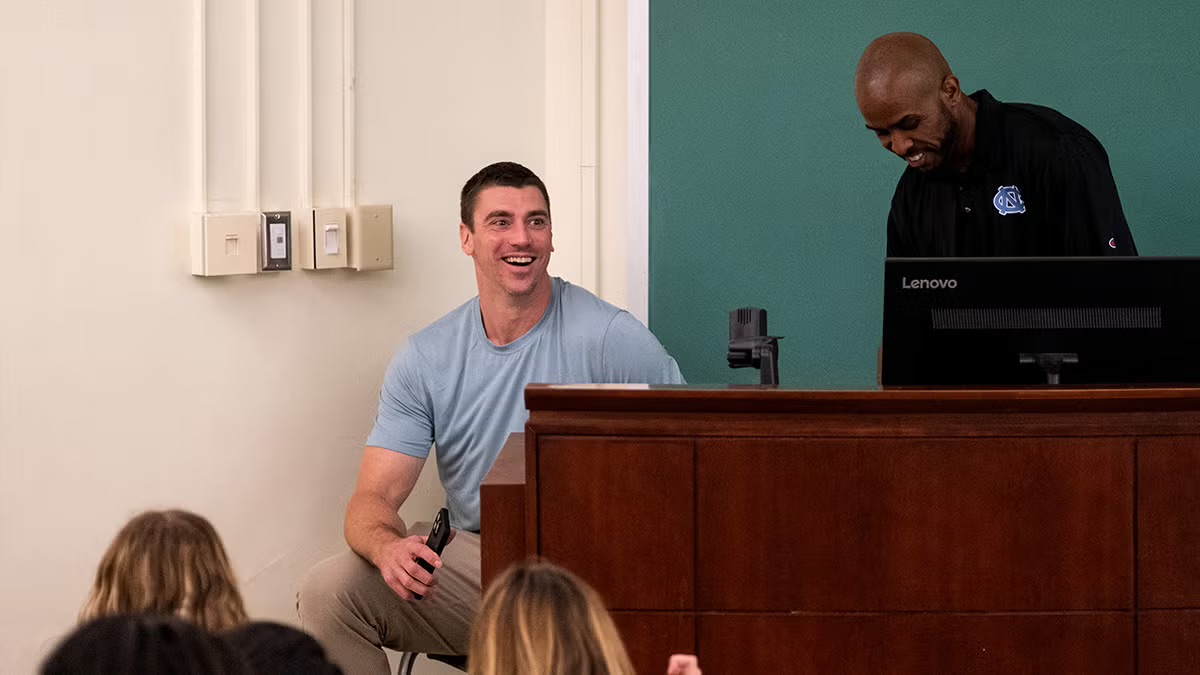

As director of UNC Hussman’s Sports Communication Focus Program, Distinguished Associate Professor of Sports Communication Livis Freeman is building on the work of the school’s legendary Distinguished Professor for Sports Communication John Sweeney. Sweeney, who retired last year, developed one of the most respected sports communication programs in the country. Freeman, now in his 12th year at the school, is launching an ambitious expansion of the program that is transforming how UNC prepares students for careers in sports media. The most visible change came this fall with a reimagining of “MEJO 377: Sports Communication.” Previously offered as two sections with 30 students each, the course expanded to 96 students and welcomed former UNC basketball star and NBA veteran Tyler Hansbrough as the co-instructor with Freeman, bringing real world professional experience directly into the classroom every week. The course has been a huge success. Students have participated in recording a podcast with Hansbrough and learned from an impressive lineup of guest speakers. Steve Kirschner, UNC’s senior associate director of athletics for communications, was the first in the course’s guest speaker series, followed by UNC Hussman alumni including Kaitlyn Schmidt ’23 from Bleacher Report, Deaton Bell ’90 from Turner Sports and Becca Royer ’19 from the Philadelphia 76ers. Travis Tygart, CEO of the U.S. Anti-Doping Agency, also shared his insights with the class. The highlight of the semester came when Roy Williams, who coached Hansbrough and the Tar Heels to a national championship in 2009, visited the classroom. Former UNC men’s basketball players Luke Maye and Marcus Ginyard showed up to support their former coach and Hansbrough, creating an unforgettable experience as Williams entertained students with stories and insights that captivated the room. Student demand has been overwhelming. The course reached capacity within two days of registration opening, with more than 40 students on the waitlist. “Students want to learn from people who have actually lived these experiences,” Freeman said. “Tyler shares insights into media relations, broadcast production and athlete communications that you simply can’t get from a textbook.” The model proved so successful that the school secured funding to continue it for the next five years, with a different former professional athlete co-teaching each fall. The school’s curriculum committee approved a proposal to expand the course to 150 to 200 students starting in fall 2026. This change will make it an introductory course accessible to students from across the University, transforming it into a showcase course for the entire campus. The course redesign represents just one piece of a broader sports communication program overhaul. This fall, the curriculum committee approved “MEJO 390: Sports Play by Play,” the first course of its kind at UNC. Limited to 10 advanced students, the course will be taught by Matt Krause, the current voice of UNC women’s basketball and an ACC Network broadcaster. Students will call actual games across multiple sports including women’s softball, soccer, volleyball, field hockey and lacrosse, as well as men’s soccer and lacrosse. They will also shadow broadcasts of men’s and women’s basketball games. “The sports broadcasting industry is exploding with streaming platforms and conference networks creating unprecedented demand,” Freeman said. The course emerged directly from student advocacy, led by Anna Laible ’26 and others who pushed for hands-on broadcasting experience. Professional equipment has been acquired, partnerships with UNC Athletics are in place and a soft launch began this semester with three experienced students calling games to test the system. The program’s growth extends into other specialized areas as well. Last spring, Stembler Professor Charlie Tuggle launched a new sports event management and hospitality course in partnership with On Location, a company that manages major sporting event experiences. The course provided students with opportunities to travel to the Super Bowl and NFL Draft, and Tuggle plans to take a group to the 2026 Milan Olympics this spring. Looking ahead to spring 2026, Associate Professor Ryan Thornburg will debut a sports data visualization course, adding another dimension to the program’s skill-building offerings. The curriculum expansion reflects the increasingly diverse career paths available in sports media, from traditional journalism and broadcasting to digital analytics and strategic communication. The program is also diving into one of college athletics’ most transformative developments: Name, Image and Likeness rights. Freeman’s “MEJO 466: Sports Marketing” class collaborated last spring with Associate Professor Gary Kayye’s “MEJO 371: Advertising Creative” class on a project with UNC’s Carolina NIL group to help rebrand their organization. That same semester, Kayye’s class envisioned Chapel Thrill, UNC football’s new pregame concert and entertainment experience. And Shaun Anderson, the school’s Knight Chair in Sports, Race and Media, continues to explore the broader implications of NIL through his research and teaching. These NIL-focused initiatives give students direct exposure to the business side of college athletics at a moment when the landscape is rapidly evolving. “Our students aren’t just learning about these changes,” Freeman said. “They’re actively helping shape how schools and athletes navigate them.” The transformation of UNC Hussman’s sports communication program reflects a broader philosophy about how to prepare students for careers in a rapidly changing industry. By bringing in professional practitioners like Hansbrough and Krause, partnering with industry leaders like On Location and ACC Network, and engaging with current issues like NIL, the program ensures students graduate with both theoretical knowledge and practical experience. For alumni who remember the foundations John Sweeney built, the expansion represents an evolution rather than a departure. The program still emphasizes strong reporting, strategic communication, ethical communication and critical thinking. But now it also offers students the chance to call live games, work on real NIL campaigns and learn directly from former professional athletes. “We’re not just teaching students about sports media,” Freeman said. “We’re giving them the tools, experiences and connections to actually build careers in it.” With new courses launching, professional partnerships deepening and enrollment expanding, UNC Hussman’s sports communication program is positioning itself as a national leader in preparing the next generation of sports media professionals. For current students, the message is clear: if you’re interested in sports communication, there’s never been a better time to be at UNC Hussman. And for the hundreds of students trying to get off waitlists and into these new courses, the school is working to create more opportunities. The program John Sweeney built is growing in ways that honor his legacy while meeting the demands of a new era in sports media.Read More

A new era for sports communication at UNC Hussman | UNC Hussman School of Journalism and Media