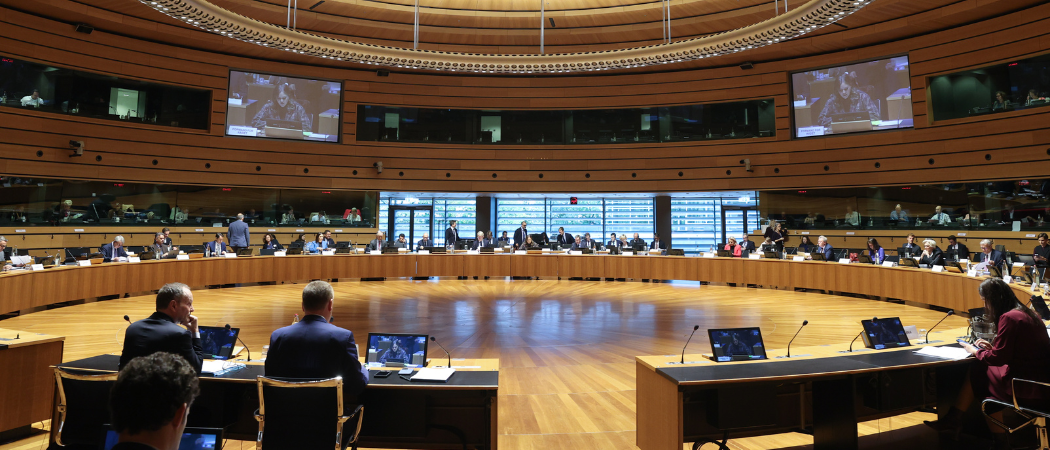

The geographical distribution of EU funding for innovative technologies is set to be debated at the highest political level, after it emerged as a possible source of disagreement during a meeting of European affairs ministers on October 21.The question of whether to include geographical criteria in the selection of projects is a long-standing debate when it comes to EU research funding, but the European Commission’s plans to launch a €234 billion European Competitiveness Fund (ECF) have pushed those divisions to the fore during wider budget talks.During Tuesday’s meeting of the General Affairs Council, several European affairs ministers, mostly from countries that benefit from measures to widen participation in Horizon Europe, called for geographical balance in awarding ECF funding. Germany led the charge in opposition to this idea, warning that it would mean corresponding cuts in cohesion funds. These are the EU funds set aside to strengthen the economic, social and territorial cohesion of the Union.Supporters of geographical criteria argue that, without safeguards, the ECF risks further entrenching innovation and competitiveness gaps within the EU as applicants from more developed economies are better equipped to win funding. Opponents counter that to compete with the US and China, ECF funds must be directed where they will have the largest impact.The issue came up during a debate on the Commission’s 2028-34 EU budget proposal, focused on the second heading, which includes the Horizon Europe research and innovation programme and the ECF, which will invest in strategic technologies that are closer to the market.The debate will inform a “negotiating box” document that the Danish presidency of the Council plans to submit to EU leaders ahead of the European Council meeting in December. The negotiating box will indicate progress on budget talks made at the technical level and identify elements that should be discussed at political level.During the debate Inês Domingos, Portugal’s secretary of state for European affairs, said the principle of excellence when awarding funds is “fundamental,” but there should also be mechanisms “that allow the more peripheral member states and regions, and the ones that have particular constraints, to be able to fully participate in boosting European competitiveness.”Czech minister Martin Dvořák agreed that measures to broaden access to funds do not undermine excellence, but are a way to spread excellence. “Widening participating should be taken care of in Horizon Europe, but also in the Competitiveness Fund,” he said.“One of the proposals is to earmark part of the ECF funds for certain member states that are less experienced in direct governance, or to have additional measures focused on member states whose [gross national income, GNI] per capita is below the EU level,” Dvořák said.Croatia’s state secretary Andreja Metelko-Zgombić likewise expressed support for the excellence principle, but called for mechanisms to ensure a geographical balance, “either including predefined allocations directly to entities from member states whose GNI per capita remains below the EU27 average, or through dedicated calls for proposals targeting those member states.”Germany and Sweden opposedOn the other hand, several member states argued that excellence should be the only criterion for awarding funding. Among the most vociferous opponents of replicating Widening measures in the ECF was Germany’s ambassador to the EU, Thomas Ossowski.“We can’t be talking about geographical distribution, we are strongly against this,” Ossowski said, adding that this was the purpose of the first heading of the Commission’s proposal, which includes cohesion funds. “When the excellence principle is called into question in the Competitiveness Fund, then the resources under heading one would be called into question.”Sweden’s minister, Jessica Rosencrantz, was similarly adamant that both the ECF and Horizon Europe should be guided by excellence. “Allocating money on grounds other than excellence will certainly not help to create European global champions. There is another, larger heading for cohesion. Let’s not mix them up or blur objectives,” she said.The issue is deeply connected to broader debates around EU spending. The reason many member states are asking for fair geographical distribution in the ECF is likely that the first heading of the Commission’s proposal foresees a reduction in the share of the EU budget that is pre-allocated at national level, said Eulalia Rubio, senior research fellow at the Jacques Delors Institute.Under the current long-term EU budget, agriculture and cohesion policy account for 62% of all spending, but their allocation in the new proposal has dropped to 44% as the Commission looks to inject greater flexibility into the budget and to tie spending to national reforms.While widening participation has always been a major topic in Horizon Europe negotiations, “I believe it’s now much more important because there’s an important cut in the pre-allocated spending,” Rubio told Science|Business. “Since the pot of funds for heading two has increased, [member states] want to have more capacity to receive part of this pot.”However, while Widening measures make sense in Horizon Europe, which has broad goals including building a unified European Research Area and supporting basic research, the ECF has different requirements as it is more focused on industrial policy, Rubio said.She warned that including geographical distribution criteria could “kill the impact of the ECF.” The EU must be able to select only the most excellent projects, “otherwise, you won’t be able to compete with other industries in China or the US that have much more financing capacity,” she said.Related articlesMEPs put Europe’s innovation gap on FP10 agendaWidening on the table as Council begins Horizon Europe talksAt the end of the Council meeting, EU budget Commissioner Piotr Serafin reiterated the Commission’s opposition to geographical criteria. “There are good reasons to stick to the principle of excellence when it comes to the Competitiveness Fund,” he said. “We cannot close our eyes on the fact that Europe is more and more lagging behind when it comes to innovation and competitiveness.”But he also pointed to the presence of “fantastic SMEs” in all EU member states. “I think that the focus of the Competitiveness Fund on SMEs opens up also opportunities for more geographically balanced outcomes of our calls for proposals.”For Eleni Dritsakou, director for policy at the European Association of Research and Technology Organisations, Europe’s strength lies in its capacity to invest where research, development and innovation (RD&I) deliver the highest impact, not through geographic quotas.“The ECF should therefore be implemented in line with the award criteria of excellence and high relevance for European competitiveness, ensuring that collaborative RD&I actions translate Europe’s research excellence into industrial strength in the long run,” she said.Differing viewsWithin Widening countries, views differ among the various innovation actors. Vendula Nováčková, head of the EU representation for South Moravia in Czechia, told Science|Business her region had not yet adopted a fixed position.“While we would naturally welcome opportunities to draw from the ECF, we also acknowledge that an excellence-based allocation can, in the long term, benefit regions with growing innovation potential such as South Moravia,” she said.The South Moravian Innovation Centre advocate awarding ECF funding only on the basis of excellence, whereas the region’s Masaryk University is more supportive of measures to ensure inclusive access and capacity-building across Europe, she said.“Lessons from Widening show that fairness and excellence can complement each other when instruments are well-designed and provide targeted support for under-represented participants,” said Nováčková, who is co-chair of the European Regions Research and Innovation Network management board.But there are also pro-active steps member states can take to support national applicants to the ECF, for instance through schemes that provide domestic funding to high-quality proposals that do not qualify for EU funding, inspired by the seal of excellence model, she said.The Council aims to reach an agreement on the budget proposal by the end of 2026.Read More

EU countries divided over geographical rules in Competitiveness Fund